“Content on this site is for informational purposes only. It should not be deemed as legal or financial advice in any way. Please view out Terms and Service that will be considered adhered to while using this service”
What Exactly is a Blockchain?

The blockchain, also known as a Distributed Ledger Technology (DLT), is a decentralized network made of up nodes (computers) that store information electronically. The most common type of information stored is transactional-related data, but transactions are only the tip of the iceberg with smart contract technology. The blockchain’s goal is to gather, record and transfer digital information in a trustless and secure way. Network participants typically consist of senders, receivers, and also miners who essentially validate and process each transaction on the blockchain. More on miners later!
One of the key advantages of the blockchain is that it operates on a peer-to-peer system that does not require any centralized entity’s. So, for example, you do not need a bank, government agency, or third-party application to send money from A to B. Furthermore, the blockchain operates in a trustless manner which means that you do not need to know or trust the people (miners) who are verifying and processing your transaction.
For a small fee, individuals can transfer assets (crypto) from one side of the world to another in minutes versus one to three days with traditional banking systems. There is no limit on the value of assets that can be sent at any one time. Unlike conventional banking systems, there is no need to explain where the funds were sourced or why and to who they are being sent. Although, you may want to keep track of this for tax purposes.
Structure and Operation of the Bitcoin Blockchain
The bitcoin blockchain is an immutable chain of back-linked blocks that store transactional data. Each block is linked to its previous ‘parent’ block and can be identified by a hash. This hash is generated by a mathematical software called the SHA256 cryptographic hash algorithm and is stored on the header of each block. The sequence of hashes linking each block to its parent creates a chain (the blockchain) going back to the first block ever created, known as the genesis block.
Each block contains specific information; see the below table.
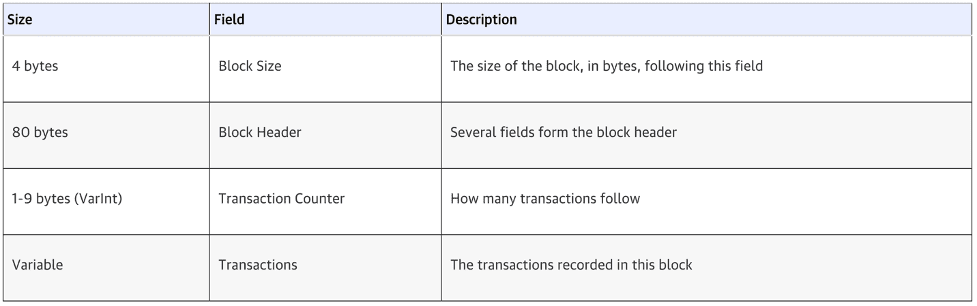
Table from; Mastering Bitcoin by Andreas M. Antonopoulos
Miners help keep the bitcoin network functioning by running nodes that are used to verify blocks of transactions on the network. In bitcoins early days, these nodes were run on standard desktops computers, but now more high-tech and powerful equipment known as Application-Specific Integrated Circuit (ASIC) are required. These ASIC machines consist of powerful graphic cards and a cooling fan system. When a transaction is placed by a network participant (you), it is placed in a block with other network transactions. Each node that has an unconfirmed block, races against each other to be the first one to solve a mathematical puzzle and hence, ‘confirm’ the block they are working on. The mathematical puzzle is highly complex and depends on a block target and the block nonce that are encoded in the unconfirmed block. The first miner that solves the puzzle wins the reward, which in the case of the bitcoin blockchain, the reward is BTC.
Once the block is confirmed, it is re-confirmed by other nodes on the network. Each time a block is re-confirmed, it adds stability and security to the block. This is what makes the blockchain so secure. The deeper the blocks, the more immutable the blocks become. If someone were trying to compromise the bitcoin network by changing the block’s data that was confirmed a month ago, all the block hashes up to that point would have to agree and also change, which is highly unlikely to happen. In the unlikely event of something like this occurring, hackers (miners) would have to control over 50% of the bitcoin network mining hash rate – this is known as the 51% Attack. Although possible, it is extremely unlikely that this will ever occur.
Thank you for reading, and I hope you found some value. Have a wonderful day!
Pauls Crypto Calls can be found via the links below:
Blog: https://paulscryptocalls.com/en/
Twitter: https://twitter.com/PaulsCryptoCall