
ALTAIR
29/09/2021What Is It
To get a better understanding of Altair, we must examine Centrifuge first. As defined by Centrifuge, “Centrifuge bridges real-world assets into DeFi (“Decentralized Finance”) to bring down the cost of capital for SMEs and provide DeFi investors with a stable source of yield; uncorrelated from volatile crypto assets.” Centrifuge, built on Parity’s Substrate, simply acts as an intermediary that enables the connection between real companies/individuals and their real-world assets (RWA’s) to Decentralized Finance services.
There are two categories of users that can benefit from Altair.
Asset Originators
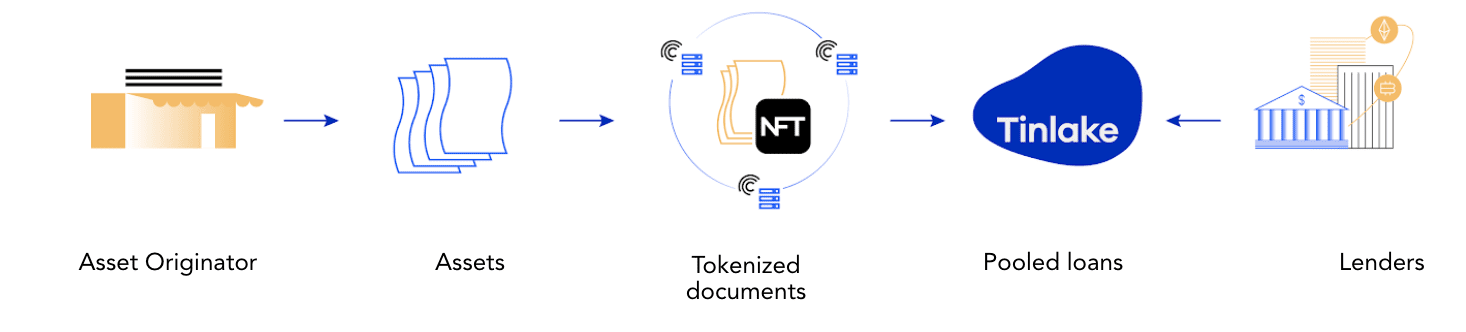
On the Centrifuge Chain, asset originators such as small and medium-sized enterprises (SME’s) can tokenize their RWA’s and use them as collateral for financing.
Lenders / Investors
Centrifuge enables Defi users (investors) to earn stable yield by investing in real-world companies. In addition, the money (stable coin) that is invested generates bankless liquidity for assets originators (AO’s).
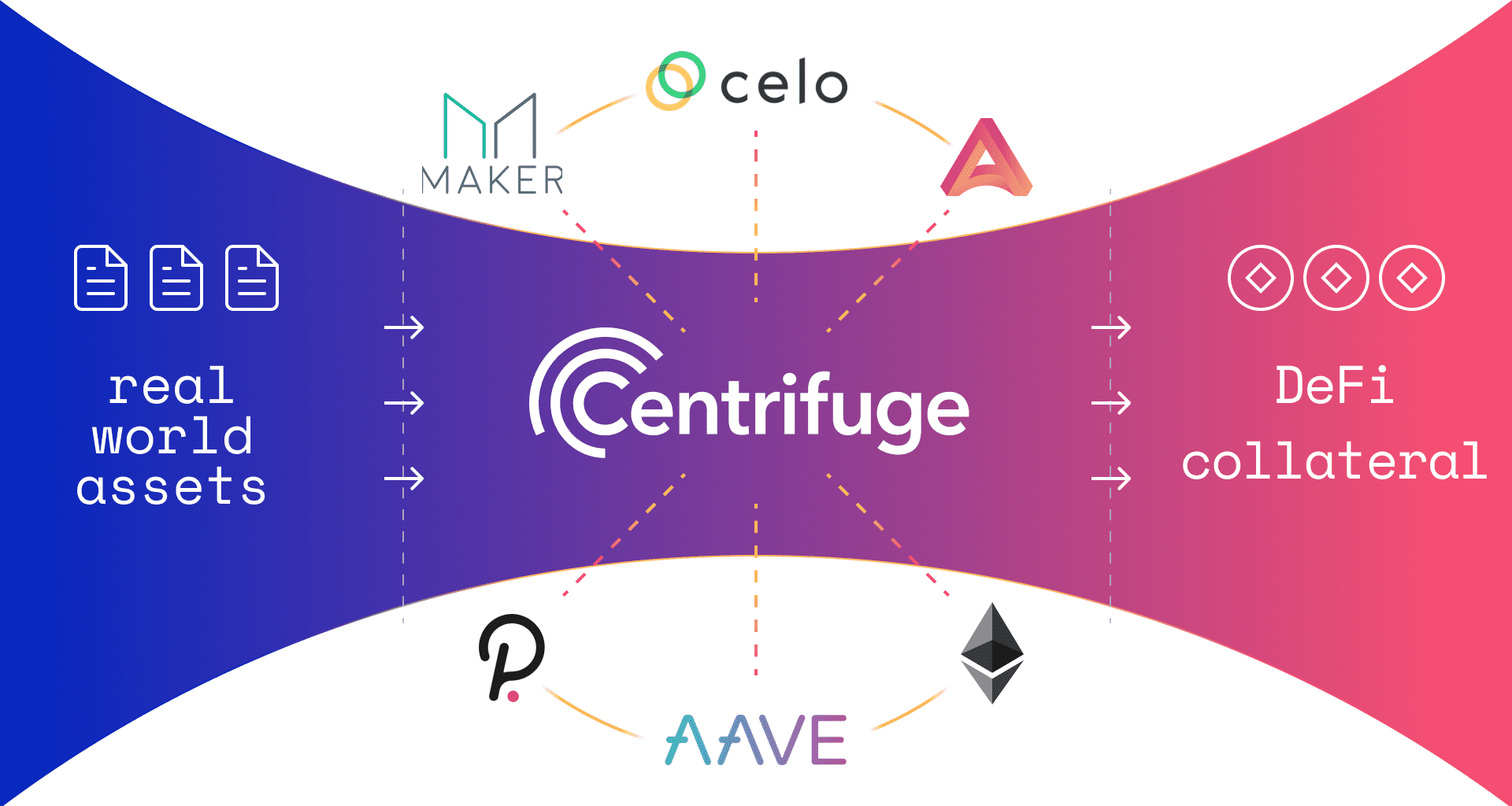
Centrifuge and Altair
Altair, built on Parity’s Substrate and bridged to Ethereum, is an experimental network for users who want to test the bounds of asset financing. As per Polkadot/Kusama’s design, tokenization of the most experimental assets and financing will happen on Altair before deployment on Centrifuge. Altair is close to identical in construction to Centrifuge Chain. However, Altair has special experimental features incorporated. Altair Chain has also secured a Kusama parachain slot. This now means that Altair can take advantage of what a Kusama parachain has to offer such as added security from the relay chain, cross-chain interoperability, on-chain governance decision making & implementation, also with extremely fast & cheap transactions! This is a massive milestone for Altair.
In addition, Centrifuge is also planning on securing a Polkadot parachain when the Poladota parachain auction process starts. There will be more details on Altair’s Crowdloan at the bottom of this review.
Note: The remainder of this review will be specific to Altair. However, please be aware that the same technology and principle applies to Centrifuge Chain.
Problems with Traditional Banking
➤ Only large businesses get direct access to liquid capital markets
➤ The value locked in traditional RWA’s is not accessible
➤ SME’s lack competitive interest rates
➤ Saving accounts offer extremely poor interest rates
Value Prop
➤ No need for conventional banking system’s
➤ Lowers the barrier of entry for originating and investing in assets
➤ Creates a bridge between the real world and DeFi
➤ Scales asset financing
How Does Altair Operate
Altair can benefit two main types of users: Asset Originators & Lenders.
Please see a real-life example below.
Asset Originators
Bob owns a lumber yard. He has business documents (invoices) showing that he is owed $10,000 from Alice, but she cannot settle for another 30 days. Unfortunately, Bob cannot wait 30 days because he has bills to pay. Bob can essentially tokenize his asset (invoice) into an NFT and use it as collateral to borrow against it at a specific interest rate. The loan will be issued in stable coin. This process is performed through Altair and the Tinlake DAPP. When Alice finally pays Bob the money owed, he can pay back the loan in full, partially, or whenever he desires as long as it complies with the terms and conditions of the loan agreements.
Lenders
Lenders provide liquidity for Bob’s assets. In exchange, lenders earn a stable yield (AIR rewards) on their investment. On the Tinlake DAPP, several companies are open for investment, all of which have various APRs.
Tokenized Assets
The list of potential assets that can be tokenized solely depends on how big your imagination is! For example, currently, assets such as invoices, mortgages, and royalties can be tokenized but this is only the starting point. Thinking out loud, it would be cool if real-estate, collectibles, entire businesses, vintage cars, helicopters, private jets, physical gold, silver, and maybe even Trust Funds could quality as asset classes eligible for tokenization. In addition, rare or high-value NFT’s such as CryptoPunks or Moonsama’s could very likely be used as collateral!
The beauty about Altair is that its use case can keep expanding to areas and sectors of traditional real-world markets. This will eventually have such a profound impact that financing through traditional banking systems will be a distant memory. Altair’s provision of accessibility, ease of use, and competitive interest rates through DeFi are major stepping stones towards mass adoption.
Features
There are two main features that fuel Altair:
➤ NFT’s & P2P Protocol/Node
➤ Tinlake DAPP
NFT’s & P2P Protocol/Node
As described earlier, when an asset originator wants to borrow against a RWA, the first stage of the process is tokenizing it as an NFT (non-fungible token). This is critical as it enables interaction with the Altair ecosystem. The asset originator’s loan details and assets attributes must be kept private. To achieve this, Altair uses privacy-enabled NFT’s, executed on a private P2P trusted (peer-to-peer) network. In addition, as per standard procedure, tracking public asset ownership is carried out on a decentralized public ledger. This combination of private and public ledgers is essential to Altair’s operation.
It is important to note that there are certain aspects of Altair that are centralized. There will be some form of entity that needs to approve/disapprove assets during the tokenization process. There will be legal structures required to onboard real-world assets. However, as per Altair team, this process may become more decentralized over time.
Tinlake
The core of the magic lies within Tinlake, Altair’s smart contract DAPP Marketplace. Tinlake unites both asset originators and Investors for the ultimate Defi experience. Tinlake, is currently built on Ethereum, however going forward, it plans to fully migrate to Altair Chain and a secure p2p protocol.
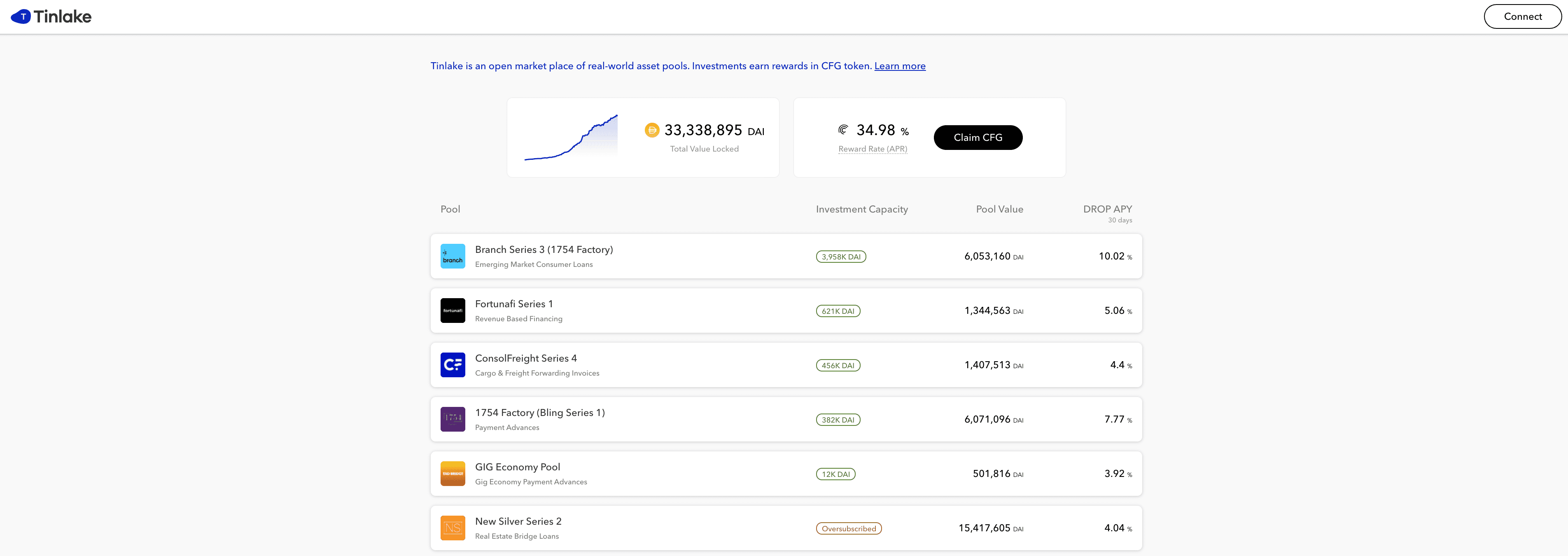
There are two different tokens that the investor can invest with, TIN & DROP
➤ TIN (risk token) – high risk / high reward (Risk token takes the risks of defaults)
➤ DROP (yield token) – low risk / low stable rewards (Yield token is protected against defaults by Risk token)
Revolving Pools
Revolving pools allow users or investors to withdraw their funds at any time. This is achieved by a decentralized mechanism that ensures Asset Originators have a constant source of liquidity while investors can flexibly invest and redeem. Please see the below image for more detail.

ChainSafe Bridge
This ChainSafe bridge (a substrate pallet implementation) simply allows the safe transfer of assets between Altair Chain and Ethereum.
Token Utility
AIR, is the native token that powers Altair. With basic functionality delegated to Kusama, the AIR token has no limits — it can become more than a traditional network token. Please see the current AIR token utilities below.
➤ Govern the development of Altair
➤ Pay for transaction fees
➤ Secure the chain
➤ Reward adoption

Incentives
➤ Staking / Security rewards
➤ Validator rewards
➤ On-chain governance
➤ Adoption Rewards
Tokenomics
There is more information to come on Altair’s tokenomics. Once available, they will be updated here. For now, please see the below chart showing distribution after lauch.

Team
Altair has a solid team with lots of experience. The team consists of alumni of many of the world’s leading organizations, including Consensys, Electric Coin Company, Parity, Goldman Sachs, Credit Suisse, SAP, Microsoft, Deloitte, United Nations, Federal Reserve, and more.
➤ Total team members – 35
➤ Software Developers – 8
➤ Advisors – 3
Lucas Vogelsang (CEO & Co-Founder) – https://www.linkedin.com/in/lucasvo/
Martin Quensel (Co-Founder) – https://www.linkedin.com/in/martinquensel/
Roadmap

Partnerships
Altair has a large number of partnerships, including, MakerDAO, Aave, and Paperchain. All partnerships add value to Altair in their own unique way. Please see the image below for further detail.

Investors
Mosaic, BlueYard, and Fintech Collective were the main contributors to the seed round with a total contribution of $8m. The second round of investments were made by investors such as Fenbushi, Galaxy Digital, IOSG, and Moonwhale. Please see below for a complete list of investors.

Verdict
Altair’s unique use case will provide so much value to SME’s and individuals that require bankless liquidity of their assets with ease of use. Altair incorporates Defi, NFT’s, RWA’s, and a Kusama Parachain. An all-in-one crypto mind-blowing package.
Altair’s DAPP Tinlake is very easy to use with good UI/UX. The fact that an investor can earn a stable yield is very admirable. RWA’s are not correlated with the cryptocurrency markets, so high volatility is less likely. This will also benefit Altair with respect to TVL, as it won’t be subjected to the same impact of sudden dips in cryptocurrency markets. This provides peace of mind when investing in real-world companies. I have no direct feedback from an Asset Originator point of view, but I can only assume that there are no major issues as there are many companies on Tinlake already running smoothly.
Altair’s successful securing of a Kusama Parachain slot complements Altair’s functionality, efficiency and adds significant value to the project. It is my opinion that Altair will do exceptionally well. There is a lot of value locked in current RWA’s that could be put to use. The benefits associated with borrowing against these assets on-chain, in a bankless way will escalate the world of decentralized finance to all-time highs. It has the potential to bring trillions of dollars into Defi. I can’t even begin to imagine where Altair will be in two years from now. Exciting times.
Altair is a unique opportunity and use case. Altair has all the right ingredients, such as a solid team, use case, backing, marketing, and the technical ability to establish themselves as the number one connection between RWA’s and decentralized finance. This multi-trillion-dollar market will hugely benefit from an innovative use case such as Altair.

Resources
https://developer.centrifuge.io/
https://medium.com/centrifuge/your-wildest-assets-competition-f2a4c9f3bf69
https://medium.com/centrifuge
Tokemak
20/09/2021What Is It
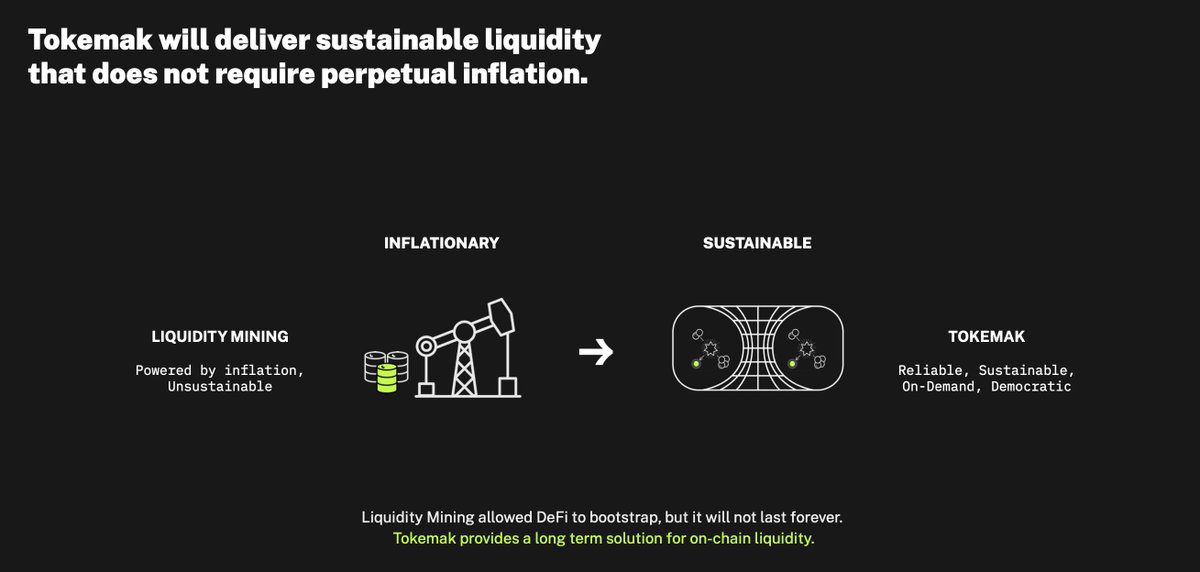
Tokemak is a decentralized liquidity engine for decentralized exchanges whose primary goal is to solve bootstrapping liquidity for new projects. Tokemak “Defi Primitive” Network is designed to generate sustainable Defi liquidity and capital-efficient markets through a convenient decentralized market-making protocol.
An example of this would be a new start-up project that needs to provide liquidity to launch its new coin. Under normal circumstances, the project needs to buy the coin it will be traded with, e.g., ETH, USDC, USDC. In addition, liquidity farms are typically set up on centralized systems such as Amazon Web Services. Both of these costs are of huge expense to new start-ups, which sometimes hinders the project’s growth. Tokemak aims to remove this costly inconvenience for new start-ups. Through their unique architecture, projects can source decentralized liquidity and have it directed to many decentralized exchanges of their choosing without providing its trading counterpart (ETH, USDC, USDC). This highly needed use case puts the cherry on top of Defi and has HUGE potential and significant benefits for all Defi users alike.
Who Can Benefit From Tokemak
➤ Liquidity Providers and Yield Farmers
➤ DAO’s
➤ New Defi Projects
➤ Market Makers
➤ Exchanges
Current Issues
Standing up liquidity for a new project is costly and inefficient
It is currently achieved by:
➤ Engaging centralized market makers (through capital, market knowledge, trading/pricing experience)
➤ Incentivizing users through yield farming
Value Proposition
Yield farming for new projects causes a strain on the health of the project due to inflationary tokenomics. This also carries high IT costs for massive server farms. Through Tokemak’s unique architecture, they directly solve these issues. In addition, a future decentralized economy requires a performant Defi base layer with sufficient liquidity for interoperability. THIS IS WHERE TOKEMAK DELIVERS! By building the first-ever Decentralized Liquidity Reactor for Defi, Tokemak has changed the future for accessing liquidity.
Tokenomics
➤ T. Supply – 100m
➤ Reward Emissions – 30%
➤ Cycle Zero’s DeGenesis Event & CoRE – 5%
➤ DAO Reserve – 9%
➤ Contributors – 16.5%
➤ Team – 14%
➤ Investors – 17%
➤ DAOs & Market Makers – 8.5%
Contributors, Team, Investors, DAOs & MM’s-(12-month cliff +12 month linear vest)

Architecture
Tokemak has two main protocol participants called:
➤ Liquidity Providers (LP)
➤ Liquidity Directors (LD)
These both play critical roles in providing and maintaining tokenized liquidity
Liquidity Providers (LP’s) deposit, e.g., ABC token into what is known as a “Reactor” & they receive a 1:1 tokenized version of that asset back in return. This process amounts to the SINGLE-SIDED liquidity provisioning for users.
Liquidity Directors – Through stakeholder governance rights, the LD’s will then choose & direct where they want the TVL (liquidity) in the Reactor to be sent. The liquidity can be sent to many DEX’s of their choosing, e.g., Uniswap, Sushiswap, Balancer & 0x.
Working Operation
Once the single-asset liquidity from the Reactor hits the chosen DEX, it’s paired with assets from Tokemak’s Genesis Pools to make a complete liquidity pair, e.g., ABC/USDC. LD’s stake quote assets in the Genesis Pools to earn TOKE rewards. Like a non-AMA exchange, real-time pricing needs to be provided. Tokemak will source what will be called “Pricers” (aka ‘market makers’) to set the bid/offer prices! There is more information coming soon on the Pricer network.
T-Assets
When an LP deposits assets into a reactor, they’ll receive a corresponding amount of t(Assets), a 1:1 ratio of their deposited assets. These t(Assets) are burned upon redemption of their underlying funds
Tokemak DAPP
The Tokemak DAPP consists of 5 pools, all of which the public can participate in and receive rewards in return. When you deposit into any of the five pools, you will receive an equivalent amount of tABC tokens.
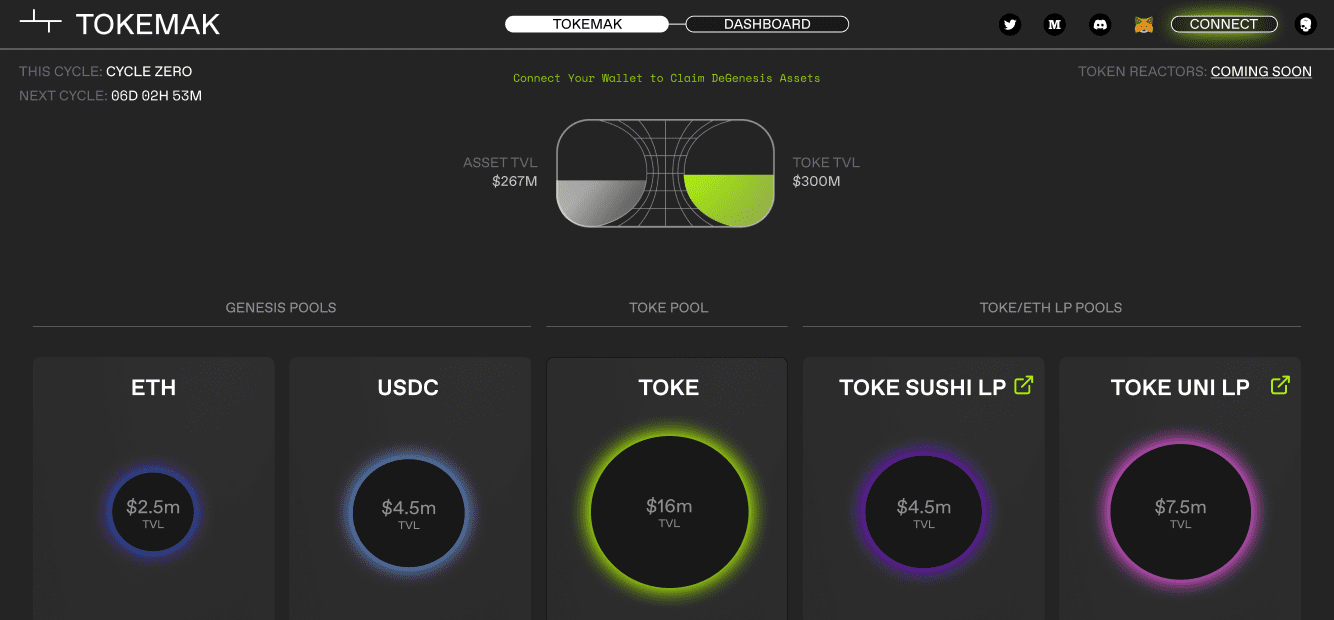
Tokemak Pools
➤ ETH and USDC Genesis Pools: will receive an equal amount of tETH
➤ TOKE Single Asset Staking: will receive an equal amount of tTOKE
➤ TOKE/ETH Sushi LP: will receive an equal amount of tSLP
➤ TOKE ETH Uni V2 LP: will receive an equal amount of tLP
Governance
➤ Unlike most chains that incorporate Governance, #Tokemak brings it to another level
➤ $TOKE holders comprise the Tokemak DAO
➤ LD’s have the authority to choose where the liquidity is provided. This is not like typical Governance in other protocols
➤ Controlling protocol fee distribution
➤ Calibrating the length of Cycles
➤ Adding new token reactors
➤ Modifying protocol safety measures
➤ Starting at a 10/1 ratio at launch – you will be able to direct $10 of liquidity from owning $1 of TOKE staked – and will be incentivized with TOKE rewards
➤ Truly is Governance on steroids
Token Utility
➤ Governance – voting rights
➤ TOKE tokens are used to collateralize the network
➤ Reward system to stakeholders
Benefits
➤ Tokemak tokenizes liquidity & directs it where needed to create yield for token holders
➤As Tokemak sources, the single-sided pool, liquidity providers for new projects do not need to place a bond for the asset that will be traded with their token3
➤ Tokemak improves capital efficiency by creating an efficient market for tokenized liquidity that can be used to bootstrap new projects or supplement existing liquidity needs
➤ DEX’s may also see the platform as a way to increase their market depth
Protocol Collateralization for Liquidity Providers
➤ If LP’s want to withdraw their liquidity but have IL, there is a protocol in place that allows for a rebalancing of assets – it will enable LP to take out what they put in!
➤ Tokemak makes LPs whole by drawing the asset in deficit from the Protocol Controlled Assets (PCA) reserve
➤ This is reimbursed by drawing system-wide asset surpluses into the PCA
Incentives
➤ TOKE can be earned through participation in the protocol
➤ Liquidity Providers & Directors will receive $TOKE as rewards
➤ Essentially, Staking or Providing Liquidity between the Genesis Pool, TOKE, or TOKE/ETH Pools, you will be rewarded3
Black Hole Effect
As Tokemak grows, its increased value can be used to supplement the LPs assets & ensure the protocol can provide liquidity & MM services without 3rd parties. This will enable Tokemak & its holders to generate more value in addition to providing liquidity
Procedure for Rewards & Cycles
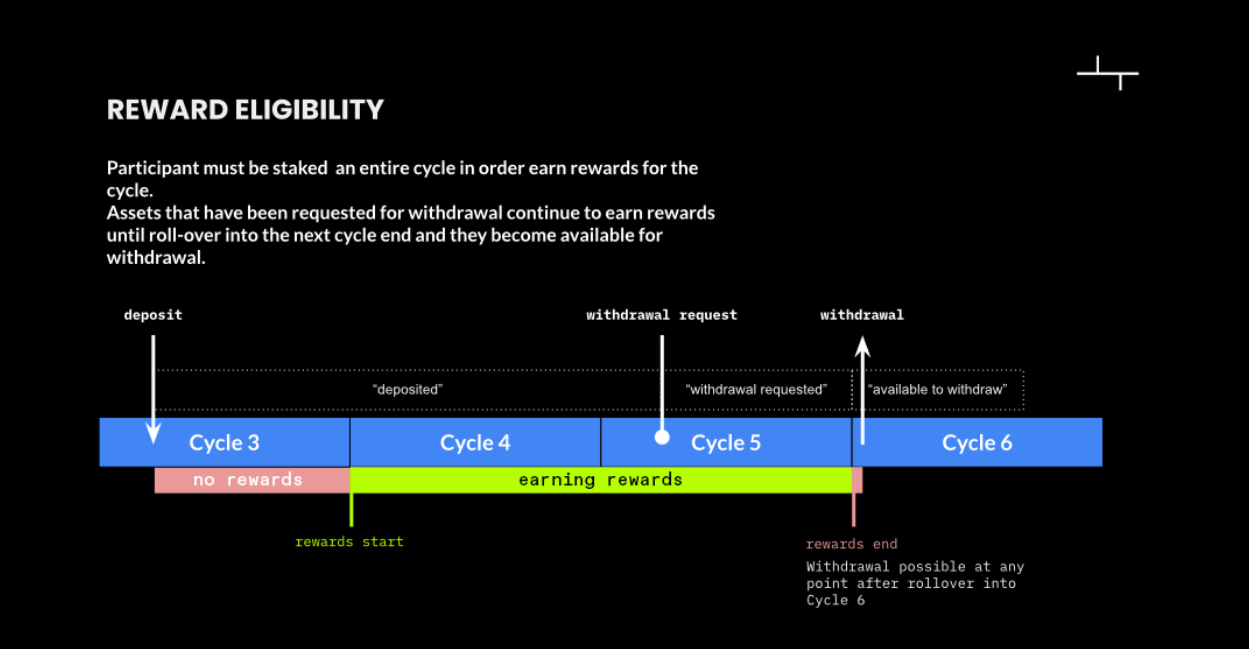
➤ If you deposit mid-Cycle, you’ll begin to earn TOKE at the start of the next Cycle
➤ TOKE rewards are only claimable weekly
➤ You must first “request” to withdraw, then the assets will be fully withdrawable at the start of the next Cycle
Partnerships
Strong backers include:
➤ Coinbase Ventures
➤ Framework Ventures
➤ Consensys
➤ Delphi Ventures
This is only the beginning. Tokemak will have every start-up and DAO eating out of their hand once it is up and running.
Team
Team size – 17
Developers – 2
Carson Cook – (CEO) – https://www.linkedin.com/in/carson-r-cook-phd-a7441738/

Verdict
Tokemak has a solid use case that many, if not all, new projects could avail of. The team has made a considerable breakthrough in Defi by creating the ultimate liquidity utility that is highly beneficial & cost-efficient. If this project team delivers and maintains their roadmap, I believe the project will gain a lot of traction in the near future.

Resources
https://medium.com/tokemak/introducing-tokemak-the-utility-for-sustainable-liquidity-8b99a4757301
https://medium.com/tokemak
https://www.tokemak.xyz/
Moonriver
16/09/2021What Is Moonriver
Before we dive into Moonriver, it is essential to know about its big brother, Moonbeam. Built on the Polkadot Network, Moonbeam is a permissionless, open-source, developer-orientated blockchain with an Ethereum-compatible smart contract platform. Moonbeam makes it easy for developers to build natively interoperable applications. It does this by providing a full EVM (Ethereum Virtual Machine) implementation, a Web3-compatible API, and bridges that connect Moonbeam to existing Ethereum networks.
As per Polkadot/Kusama design, code will be tested and experimented on Moonriver before deployment on Moonbeam. Given the success of Moonriver to date, the team has decided that Moonbeam and Moonriver will now be independent of each other and unique in their own way. Moonbeam’s code will still be experimented on Moonriver, but the two infrastructures will essentially have their own desirable functionalities and communities!
Moonriver has recently secured a Kusama parachain slot, and Moonbeam aims to deploy on Polkadot later this year, 2021. This has been a massive milestone for the team, and rightly so. As a parachain on the Kusama Network, Moonriver will benefit from Kusama’s relay chain’s shared security and integrations with other chains connected to Kusama. The same principle will apply to Moonbeam on Polkadot. It is important to note that Kusama was created for testing code before deploying on Polkadot. Both Polkadot and Kusama are identical to each other.
For the remainder of this article, I will just refer to Moonriver and Kusama, but please be aware that the same theory applies to Moonbeam and Polkadot.
What Is Moonriver Solving
Moonriver is solving two mains issues that are plaguing the cryptocurrency sector.
Network congestion on Ethereum – slow transaction speeds and high transaction costs are still a concern for Ethereum. In addition, there is no clear indication of when Ethereum will finally make the switch to Proof of Stake.
Cross-chain Interoperability – the inability for blockchains to communicate with each other. New chains are being developed, aiming to solve Ethereum’s problems, but these new chains lack interoperability, creating more issues.
Moonriver and Ethereum
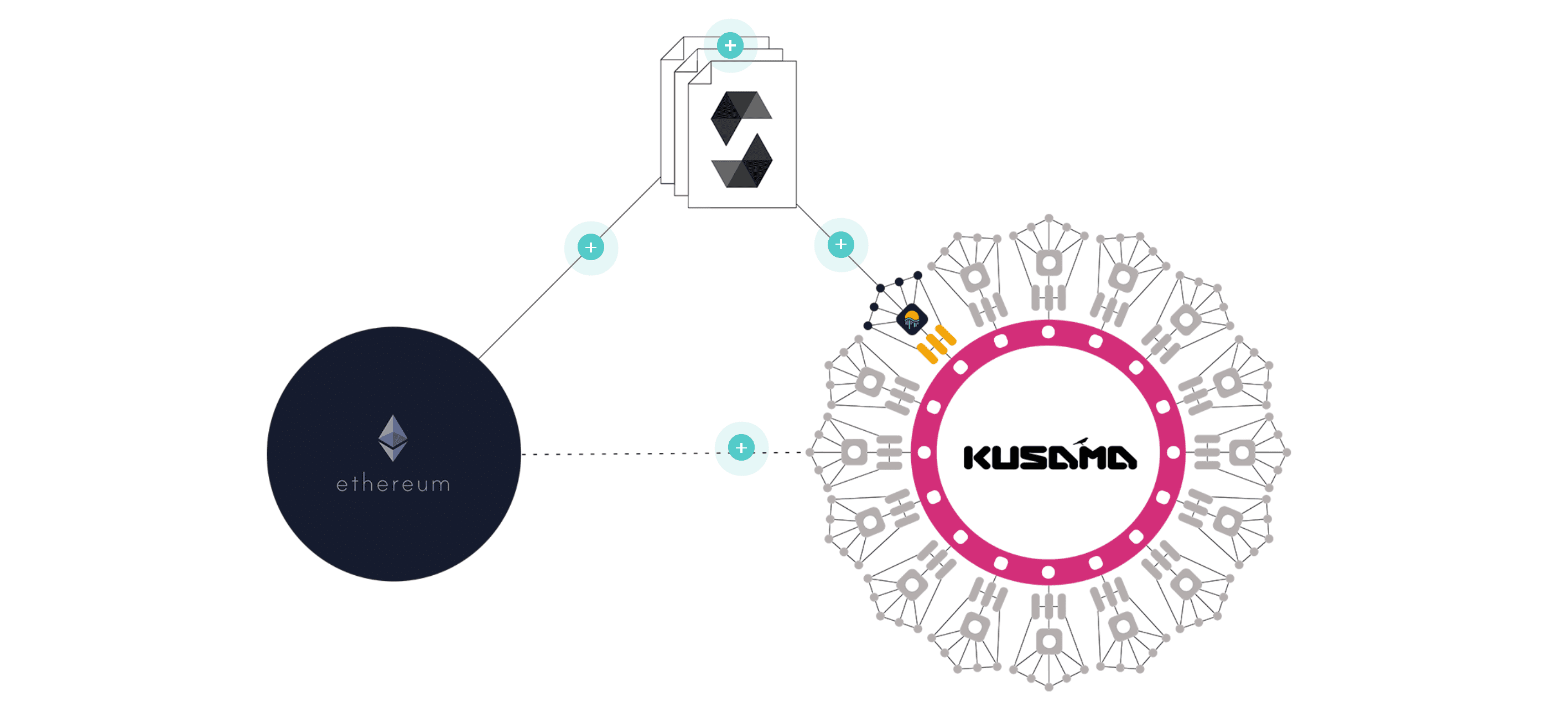
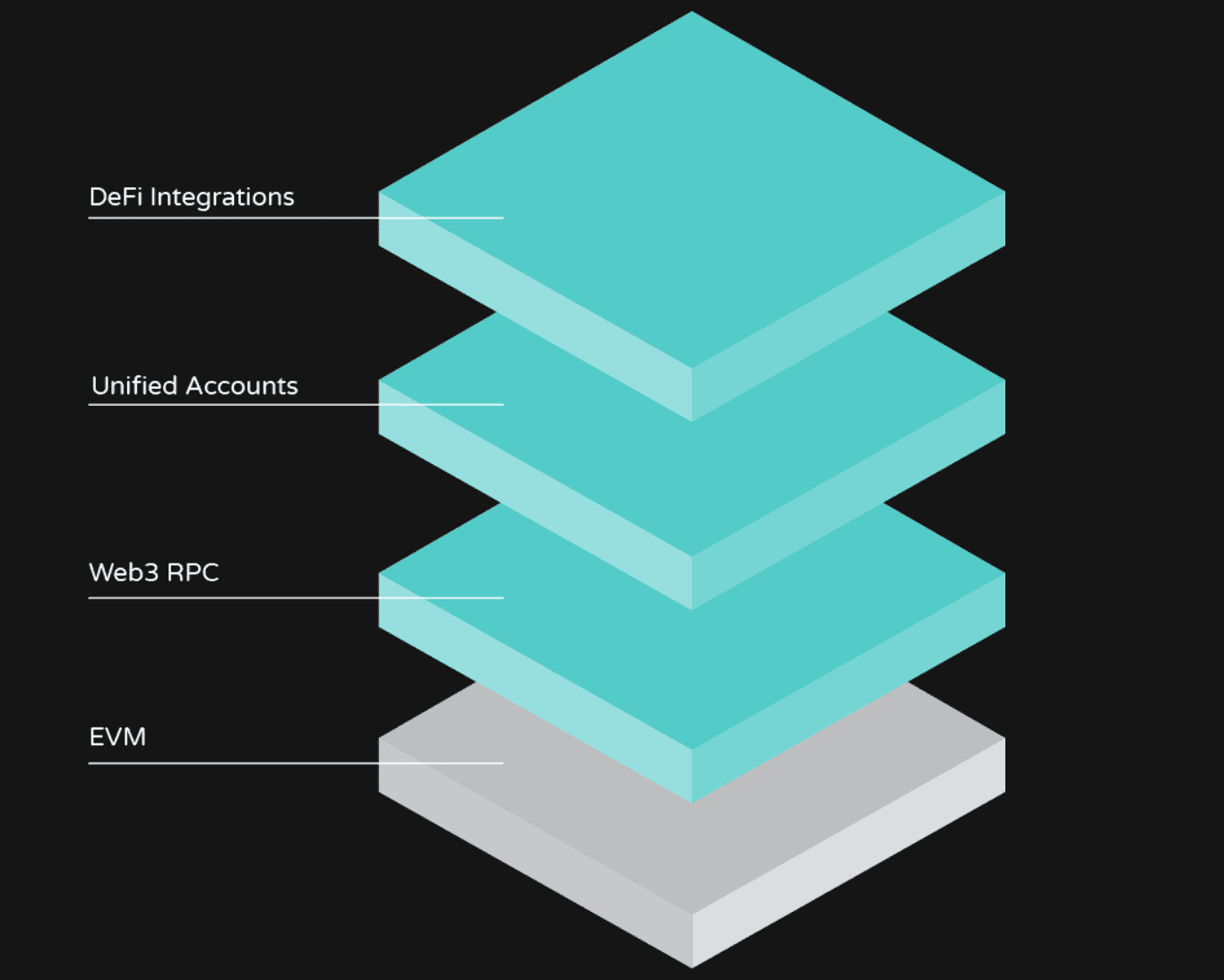
Moonriver allows Ethereum based projects to easily connect and interact with all parachains within the Kusama ecosystem. So how does this happen? First, let’s look at Moonriver’s EVM. Moonbeam and Parity Technologies developed an Ethereum Virtual Machine (EVM). An EVM, module (Frontier) is one of many “pallets” that can be easily installed in a substrate base blockchain.
This EVM simply enables new and existing Ethereum based projects to easily build on or transfer their entire project onto Moonrivers platform. There are thousands of Ethereum based projects that suffer from network congestion and its side effects. Moonriver provides an escape route and solves these issues, all without changing any solidity-based code. Genius.
Features and Benefits
Cross-Chain Interoperability
By implementing the EVM (described above), Moonriver enables Ethereum to interact with other chains within the Kusama ecosystem. This interoperability is a huge advantage for users and projects as it allows for data and asset transfer, price discovery, and market liquidity.
Thanks to Moonbeam and Parity, each one of the one hundred parachain slots on both Polkadot and Kusama will have the option of implementing a full EVM onto their Substrate based blockchain! So imagine one hundred different blockchains, Ethereum compatible, all communicating with one another under the same roof!
In addition, Polkadot has created a cross-chain messaging service that will enable all parachain’s to communicate with one another. This will allow them to share trusted logic with each other.
Transfer of Tokens
Moonriver allows for the movement of tokens from other chains into Moonbeam-based tokens. Use cases for these tokens could be Defi and other applications on the platform. These assets can either be transferred back to Moonriver or sent to other chains depending on user requirements.
Permissionless DAPP’s
Decentralize applications (DAPP’s) can be migrated from Ethereum straight onto Moonriver without any difficulties.
Advanced API
Moonbeam also provides a powerful API that allows for enhanced Web 3.0 access and ease of use when deploying Solidity smart contracts and DAPP’s.
On-Chain Governance
Unlike Ethereum, Moonriver will provide on-chain governance features based on Substrate functionality. These on-chain governance modules include functionality to power upgrades to the blockchain itself based on weighted token voting. Any on-chain decisions made by the community can be implemented without the need for any forks.
Unified Accounts
Unified Accounts simply allows a user to avail of the features provided by both Substrate and the EVM by holding one single H160 address. Yes, the user gets the best of both worlds from the Polkadot/Kusama & Ethereum Ecosystems, with on-chain governance, staking, and cross-chain interoperability features.

Direct Advantages For Developers
Developers can deploy existing solidity smart contracts to Moonbeam and gain access to Polkadot’s growing market. In addition, Moonbeam allows you to keep the same tools, programming languages, and accounts you already use.
When migrating to Moonriver, there is no need to re-write or configure any contracts. Furthermore, everything can be tested in a safe testing environment that is 100% compatible with the Ethereum developer toolchain!
Moonriver accepts all familiar languages such as Solidity, essentially anything that compiles to Solidity bytecode.
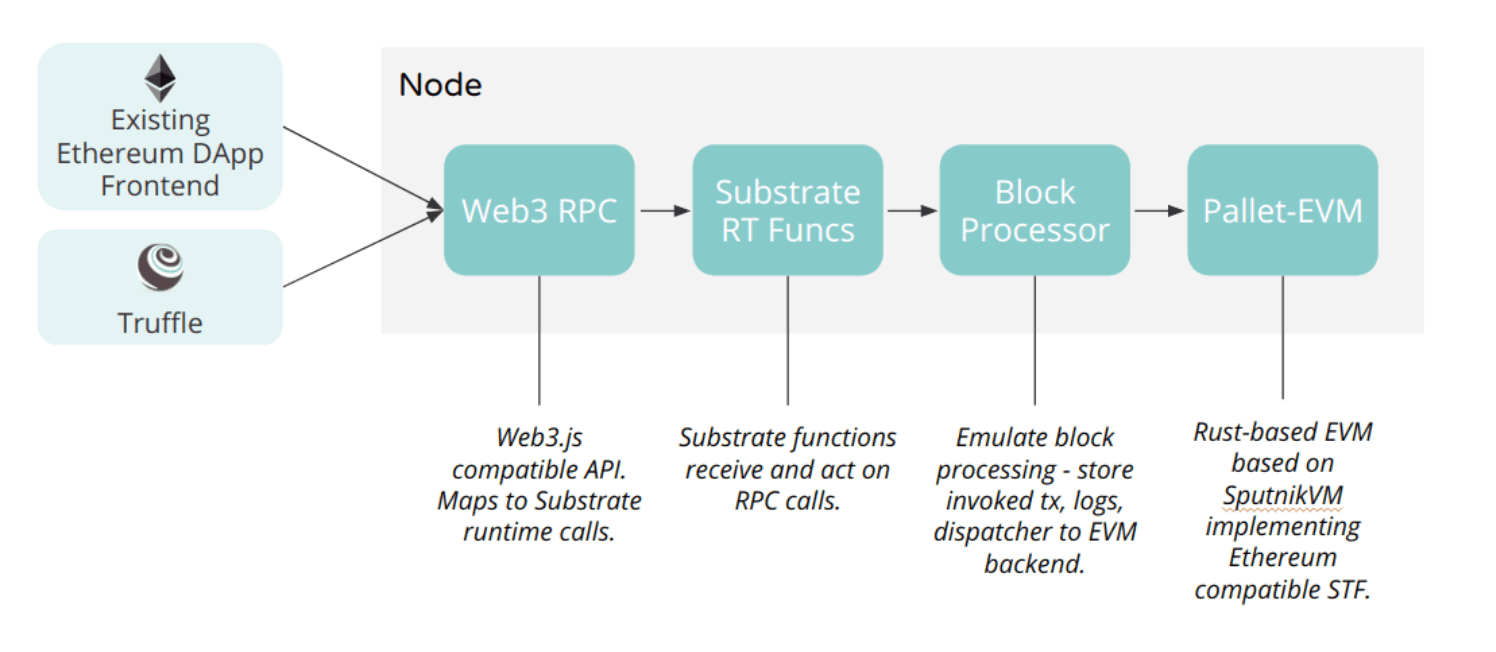
Use Existing Tools and DAPP Frontends to connect popular tools like MetaMask, Remix, and Truffle via a complete set of Web3 RPC endpoints. Also, well-known Javascript libraries such as Web3.Js or Ethers.Js can help developers.
Token Utility
➤ Transaction fees on the network
➤ On-chain governance mechanism
➤ Proof of Stake – chain security
➤ Supporting the gas metering of smart contract execution
Tokenomics
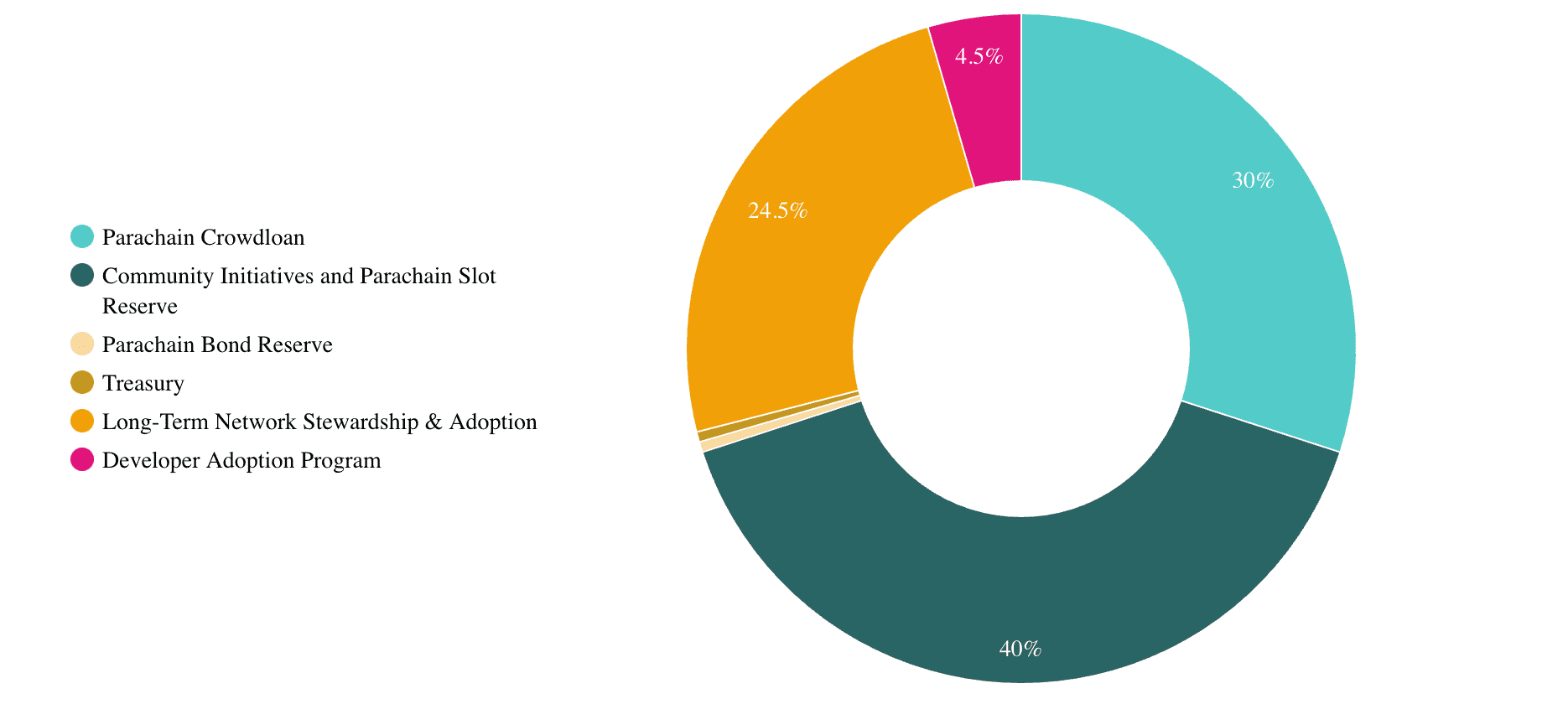
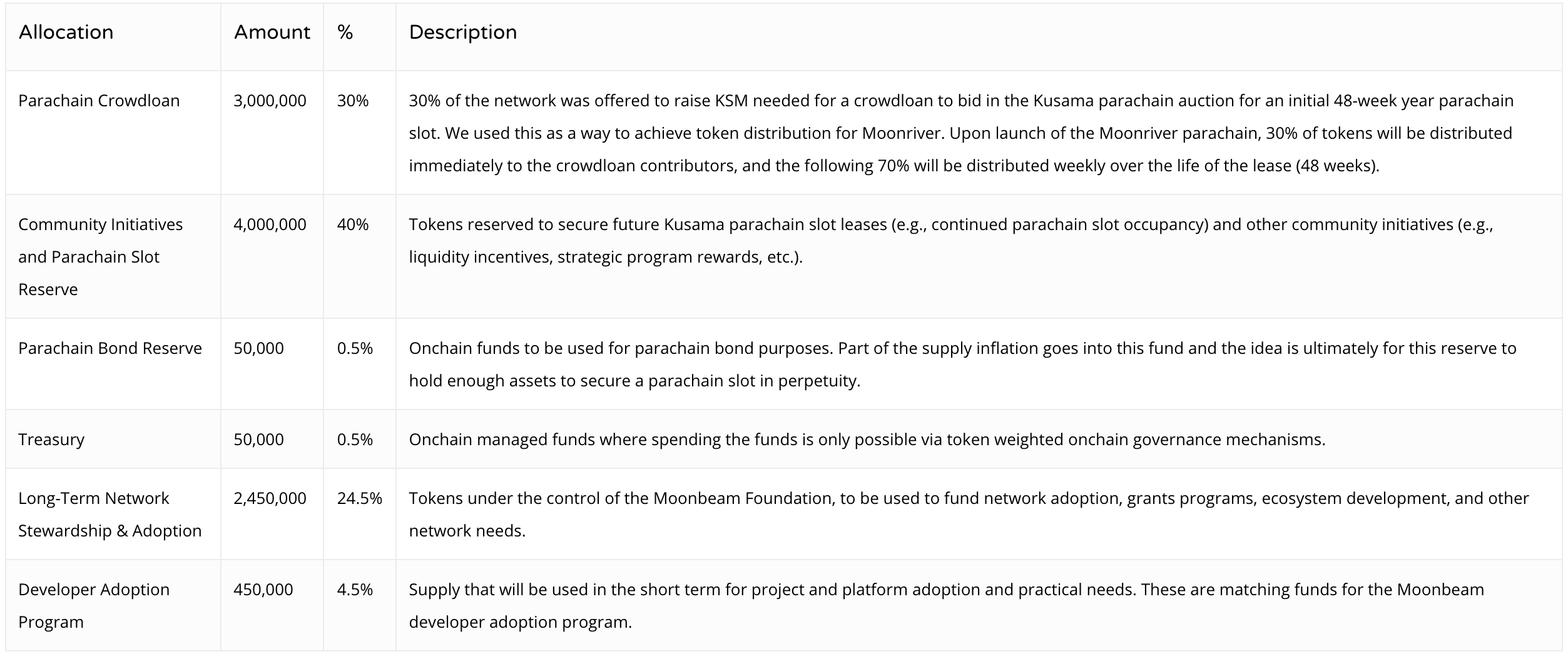
Very attractive tokenomics and vesting schedule. No Private Sales, VC’s or Seed Rounds
30% tokens are allocated to the parachain slot (community-owned)
40% of supply held for future Initiatives and Parachain Slot’s
Total Supply: 10 million
No max supply as the project is Inflationary due to block rewards
Please see further detail in the images below.
Partnerships
➤BwareLabs
➤Polkamarkets
➤Seascape
➤Subscan
➤Equilibrium
➤OnFinality
Integrations
➤Yuser Inc.
➤Lido (Integrate and collaborate)
➤CREAM Finance
➤Figment
➤Impossible Finance
➤Covalent
➤Jambb
➤myNFT
➤Waffle
➤Mars
➤Cardinal Entertainment
➤OpenZeppelin
➤API3
➤Convergence Finance
➤Polkassembly
➤Axelar
➤Frax Finance
➤Orion Protocol
➤Balancer
➤Human Protocol
➤IDEX
➤Chainlink
➤Band Protocol
➤Ocean Protocol
➤ChainBridge
Investors
➤Arrington XRP Capital
➤Coinbase Ventures
➤Fenbushi Capital
➤Hashkey
➤KR1
➤Signum Capital
➤IOSG
➤A195
➤Binance Labs
➤Coinfund
➤CryptoDiscover
➤D1 Ventures
➤GBV
➤Moonboots Capital
➤Parafi Capital
Incentives
Staking Rewards – check out link https://moonbeam.network/tutorial/stake-movr/
Collators Rewards (block producers)
Roadmap
The team are currently working on the following
➤ Continuous integration of projects and deployment Moonriver
➤ Kusama integration which includes work required to support relay chain functionality – staking from Moonriver based smart contracts.
➤ Asset integrations to other parachains
Team
Team size – 33 employees
Developers – 9
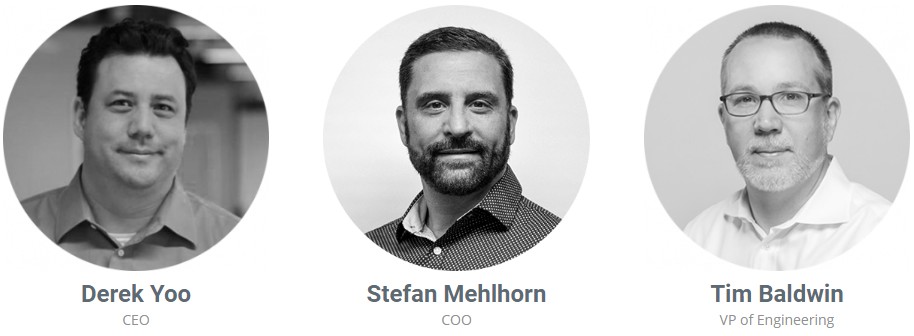
Derek Yoo (CEO of Moonbeam & PureStake) – https://www.linkedin.com/in/derek-yoo-8a050/
As a serial as-a-service technology entrepreneur, Derek has been building successful software and cloud companies for more than 20 years.
Stefan Mehlhorn (COO at PureStake &. Moonbeam –https://www.linkedin.com/in/stefanmehlhorn/.
Technology executive and entrepreneur with a broad skillset and international expertise. He is experienced in leading multi-functional and multi-cultural teams in high-growth, rapid pace innovation environments.
Verdict
Moonriver is like the ultimate hybrid blockchain. Combining the robust architecture, high security, and true decentralization of Kusama with Ethereum’s smart contract capabilities, and large ecosystem Moonriver is a feature-rich, multi-chain beast.
The value that Moonriver is bringing is something that crypto land has been crying out for. Moonriver combines the unique qualities of Kusama’s ecosystem with Ethereum’s smart contract compatibility to solve two main issues, cross-chain interoperability, and network congestion.
Moonriver has a specular team. They have been executing milestones in a timely fashion and have gained the respect of the wider crypto community. I take my hat off to the entire team.
In my option, this project is here to stay. Furthermore, I see it embedded in the top twenty in the near future (not financial advice). The technology and value presented cannot be denied and should be considered an asset, not just to token holders but also to projects that want a quality infrastructure to build on.
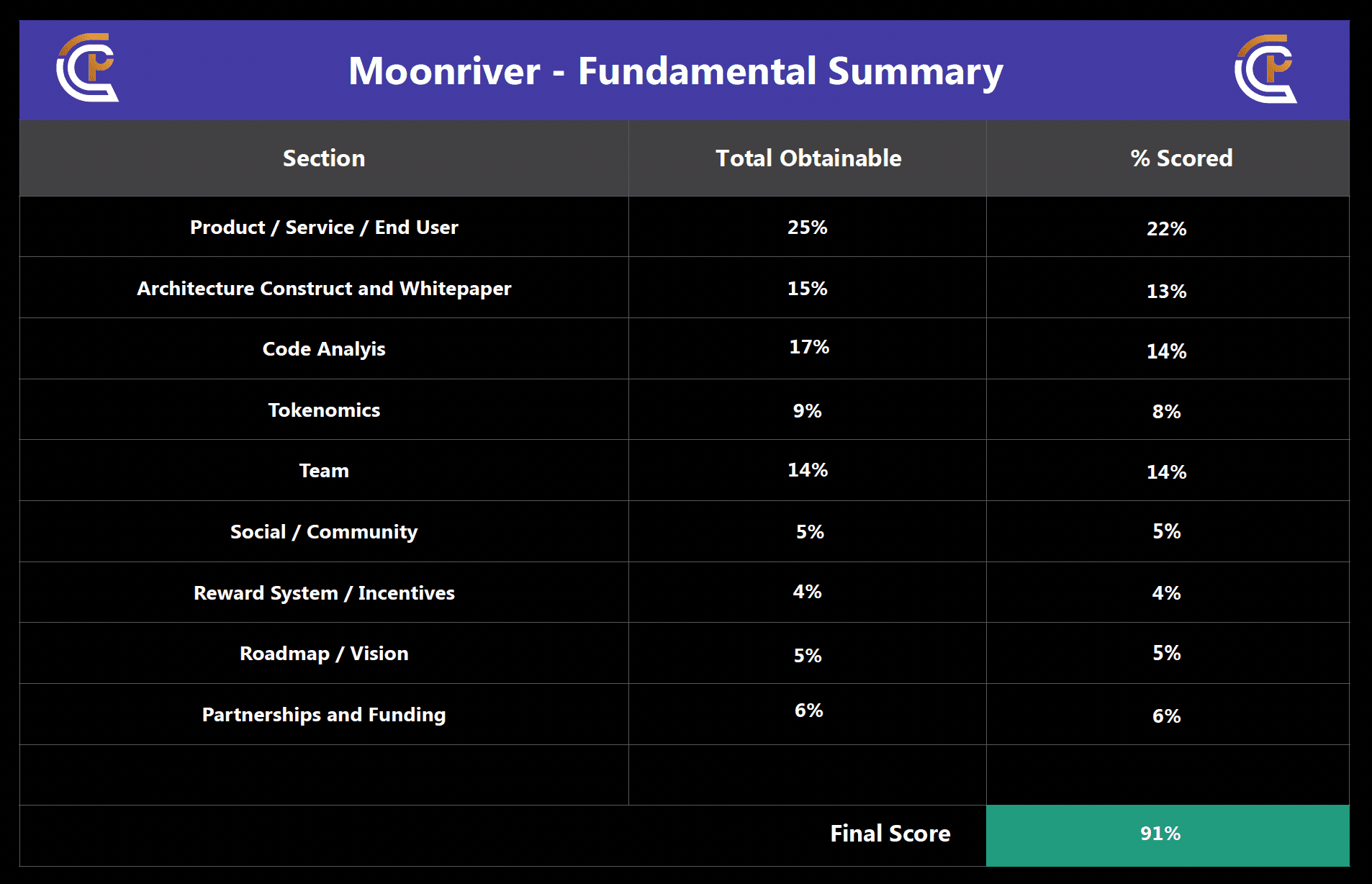
Please see the fundamental analysis results summary below.
Efinity
14/09/2021Enjin – Creators of Efinity
First, let’s recap on Enjin, the creators of Efinity. Enjin launched in 2018 and has been highly successful in the NFT space, with the current MC sitting at $1.3b MC. It is one of the first NFT creation platforms which allows for the tokenization of assets. Enjin enables game developers to issue fungible and non-fungible assets such as game tokens ETH tokens. Its NFT tool kit allows for the development, distribution, storage of tokenized assets. Enjin is also the author of the next-gen ERC-1155 token standard!
What Is Efinity
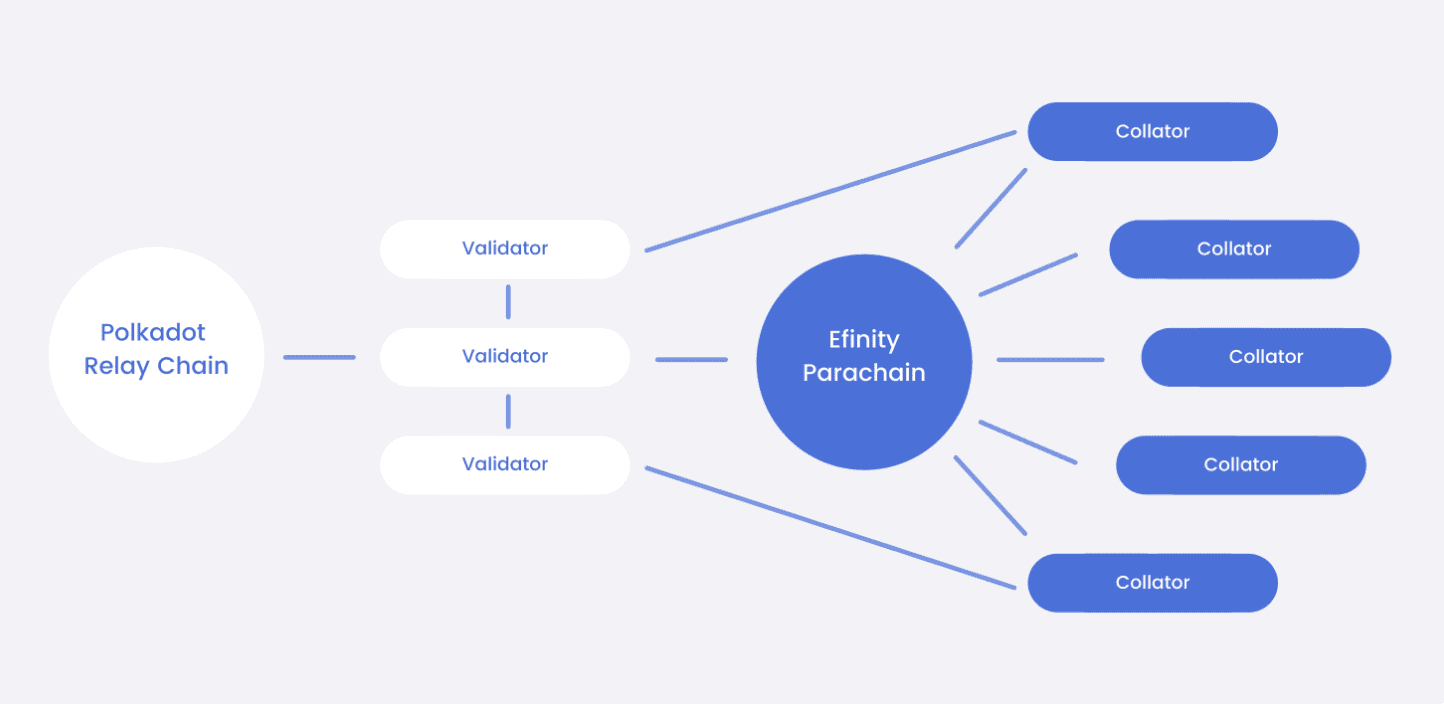
Efinity is a purpose NFT HIGHWAY built blockchain specifically for NFT users!
➤ Next-generation blockchain built as a parachain on Polkadot
➤ Estimated 700 – 1000 TPS
➤ Transaction batching
➤ Transactions confirmed in 6 seconds
➤ Polkadot relay chain security
Problems with Current NFT Marketplaces
➤ Slow transaction speeds
➤ Disjointed interoperability
➤ Inflexible smart contracts
➤ All rewards go to the miners
Multi-Chain NFT Ecosystem
➤ A hub for tokenized assets / NFT’s
➤ Mint and create millions of NFT’s for PENNYS!
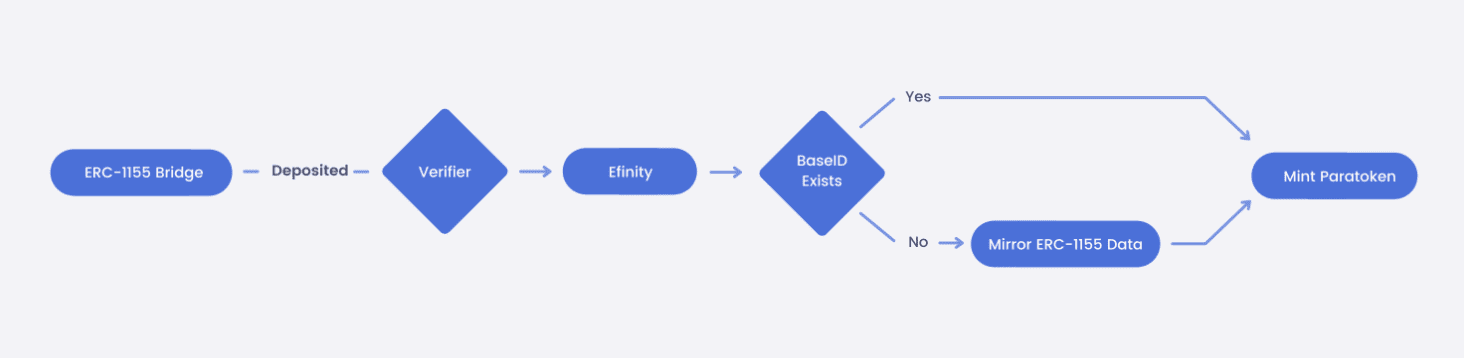
➤ With Paratoken technology, any NFT from any chain can be moved to Efinity, supercharging it with next-gen features
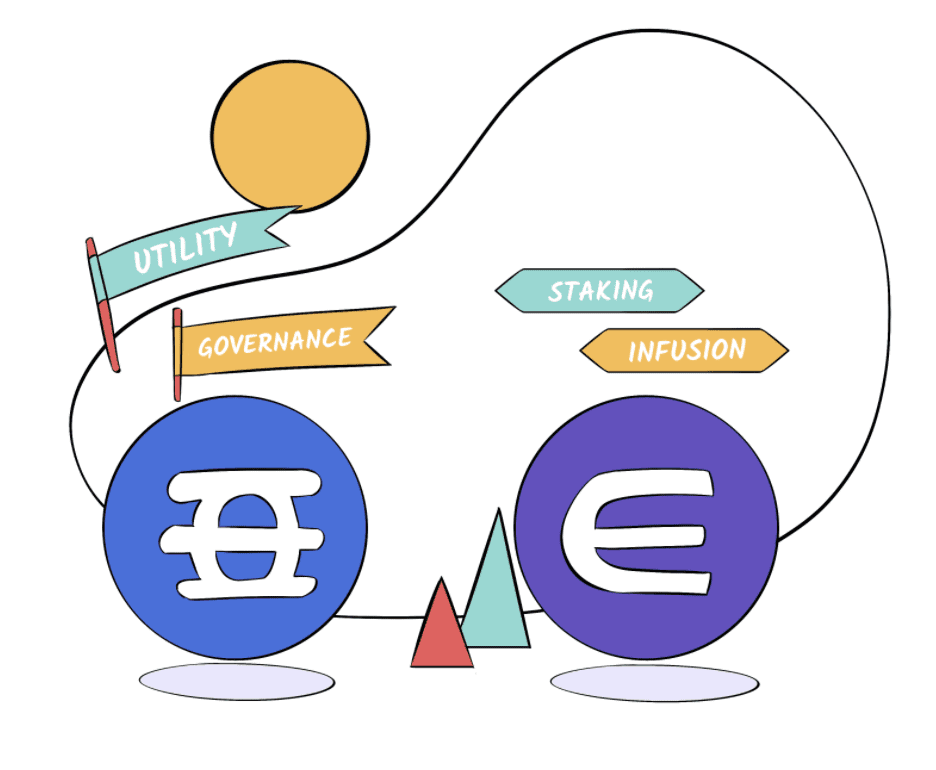
Token Utility
Every asset on Efinity can be exchanged for any other NFT or other digital tokens that are bridged onto the network.
An imported coin such as ETH can be exchanged for a non-fungible token since both are interoperable Paratokens!
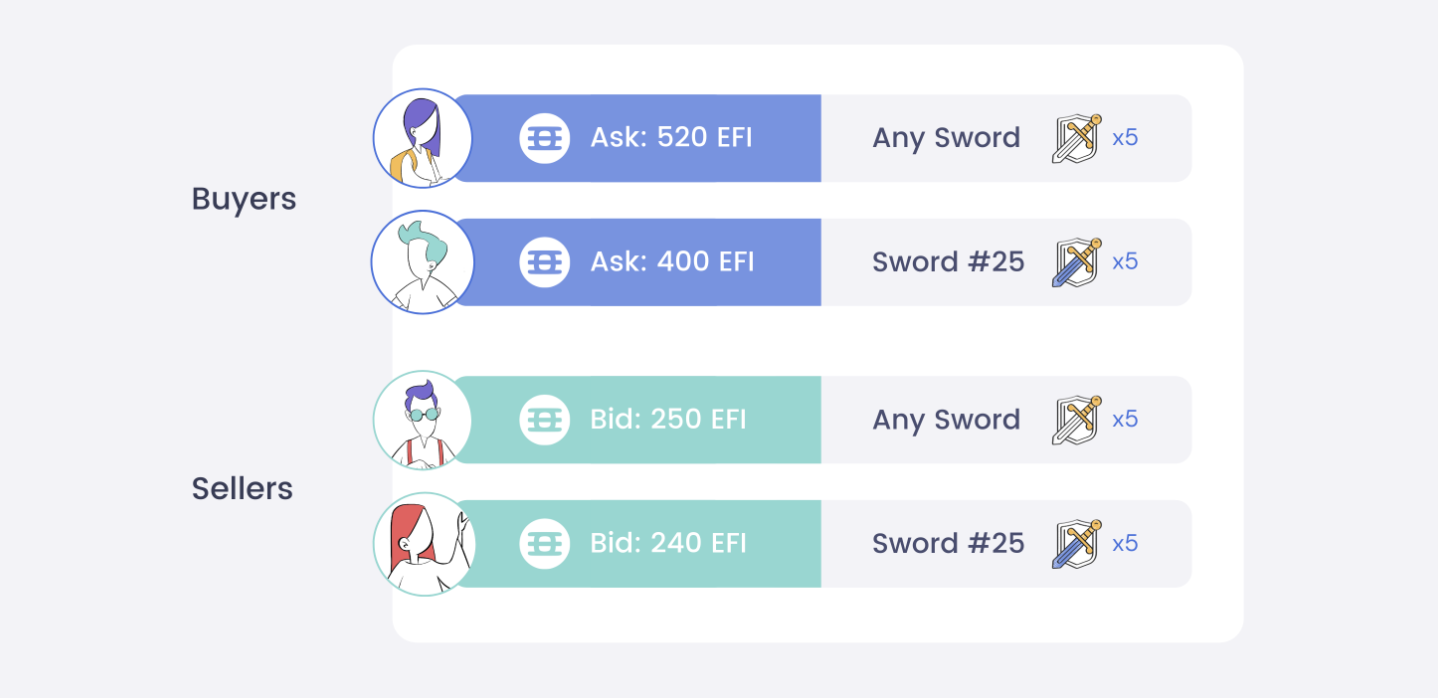
➤ Transfers & Bid/Ask Orders
➤ Liquidity pools
➤ Bridges
➤Smart Contracts
➤ Governance
➤ Marketplace Orders
➤ Network Transaction Fees
➤ Developer Fees
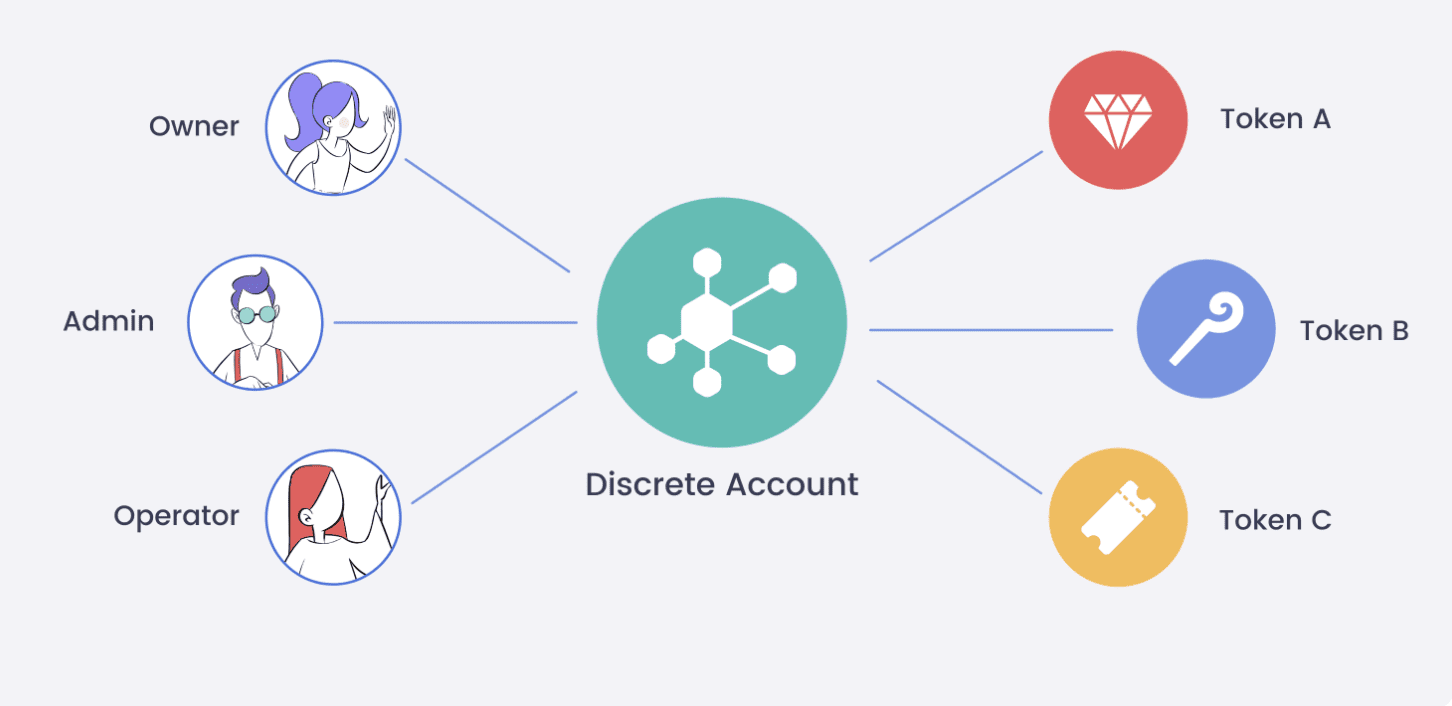
➤ Discrete Accounts
➤ Fuel Tanks
➤ Jump Net
Paratokens
Imagine a custom-built NFT blockchain on Polkadot, running on a Parachain.
Cross-chain interoperability with its own NFT Token Standard that is compatible with the entire Polkadot and Kusama ecosystem.
Multi-Chain Hub – Increased Network Effects
➤ Increased volumes of transactions across all chains
➤ Massive increase of liquidity in the NFT space across multiple chains
➤ Use cases will connect a broad ecosystem of buyer’s users & sellers
NFT.IO – Built by Enjin, powered by Efinity
➤ Built by Enjin and powered by Efinity, NFT.io is the flagship NFT marketplace for Efinity
➤ Another step closer to mass adoption
➤ When it goes live in December 2021, users will have access to the whole NFT.io marketplace experience, including auctions and re-listing/trading capabilities.
Beam
Beam is a first-of-its-kind tool that can deliver NFTs to anyone via a simple QR code scan. Available to partners like Microsoft and SwissBorg in private access, Beam has already been used to distribute over 500,000 blockchain assets
Fee-free transactions on JumpNet have reignited the demand for this technology, with over 350,000 items Beamed since the network’s launch this year. Efinity is looking at a capacity of 100,000 NFTs per Beam campaign, with plans to expand this to millions – this is completely insane
As Efinity develop and scale Beam, they will be opening the self-serve platform in Early Access in Q4 of 2021, allowing anyone to distribute NFTs to a broader audience easily
Enjin Wallet 2.0
Enjin’s native flagship wallet has been continually worked on since 2018. The team have been making improvements, iterations, and adding features, from blockchain gaming support to integrated exchange platforms.
With increasing demands for multi-chain, Defi, and NFT capabilities, Enjin is evolving the wallet to be a more robust, seamless, social experience than ever before. In addition, they have increased their mobile development team to deliver a top-of-the-line app experience, which will also tie into key Efinity features like staking (collator nomination).
Walled Gardens
Fragmented blockchains and marketplaces result in walled gardens that compete for liquidity and hurt the growing digital metaverse. Enjin (with Efinity) aims to eliminate “Walled Gardens”, restricting the flow of in-game items from one game to another. In addition, Enjin aims to solve the challenge of facilitating the pricing and exchange of NFTs. This will create network effects by attracting increasing volumes of transactions.
Enjin Multiverse
Enjin-powered NFTs are now usable in multiple gaming universes, creating a borderless user experience where players can slide through digital dimensions with a persistent identity and inventory.
Built by Enjin on Ethereum as a cross-platform project that integrates MULTIPLE GAMING WORLDS into a UNIFIED MULTI-VERSE experience
Fuel Tanks
➤ These are special Discrete Accounts that are used purely for transaction fees
➤ Creators can choose to subsidize customers cots by depositing EFI tokens to their Fuel Tank
➤ A fuel tank can whitelist specific tokens, tags, transaction types or specific users
Crafting
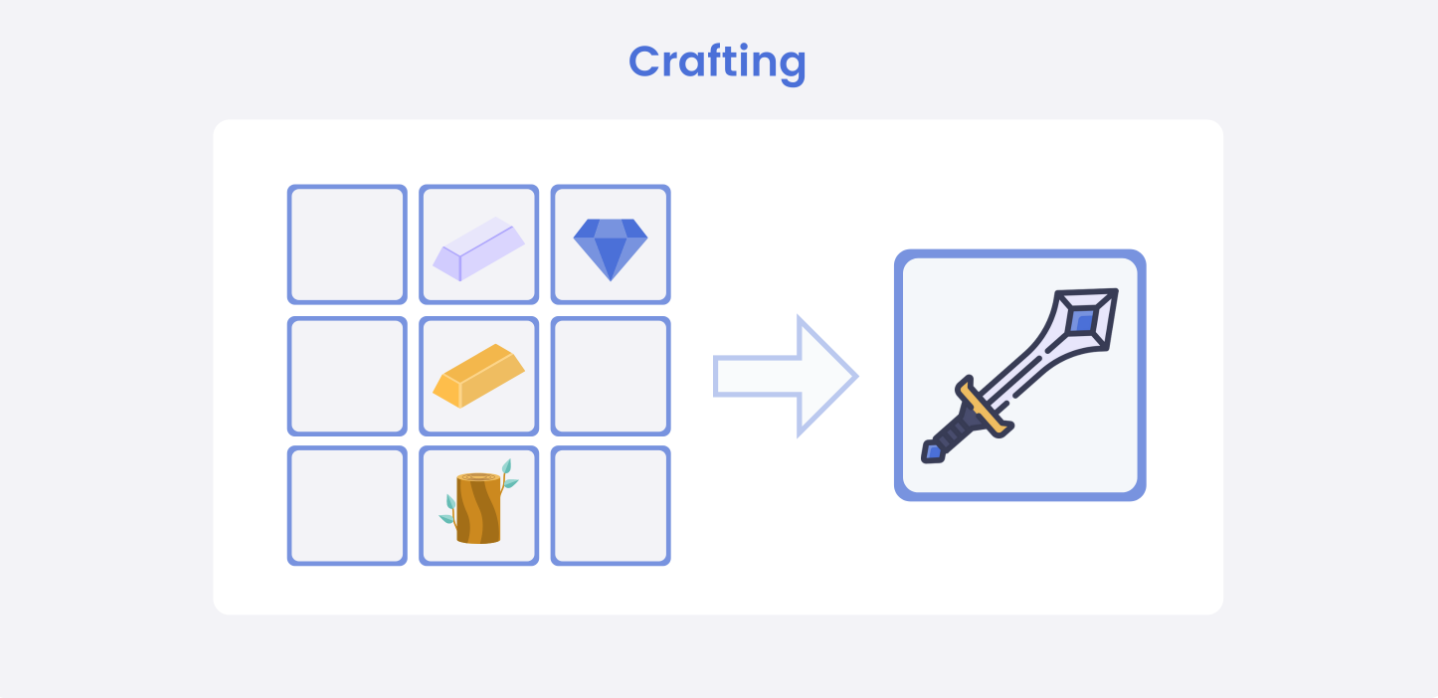
The CRAFTING feature is so cool. It basically allows existing tokens to be modified, created by using a RECIPE
A recipe may require ownership of specific tokens (e.g. Hammer & anvil)=
It can be coded to perform several actions: minting, burning, melting or transferring
EfinitySwap
EfinitySwap is essentially a feature that helps with the exchange of Paratokens
➤ It happens by allowing automatic conversion of Paratokens into other Paratokens without friction
➤ Existing Bid & Ask orders are used to facilitate these swaps
Efinity’s Price Discovery Pool
Efinity’s Price Discovery Pool was created to facilitate the development of third-party apps using Efinity to transfer NFTs to other blockchains
To incentivize users to place Bid Orders, the top (un-filled) bids for each Paratoken will receive $EFI from the Price Discovery Pool ?
JumpNet
➤ As a free, carbon-negative solution, JumpNet has made it possible for users to mint and distribute non-fungible tokens (NFTs) without fees—or concerns about the environmental impact
➤ Enables forever-free Ethereum transactions. A fee-free blockchain!
➤ Holding EFI on JumpNet (JEFI) increases your transaction limits so that you can enjoy instant, free NFT and ENJ token transfers on-chain
Planed for 2021 Q4
➤ Smart contracts will enable projects like Forest Knight, Space Misfits, Ether Legends, and Spirit Clash to launch their own ERC-20 tokens, create robust marketplaces, and implement unique minting mechanics.
➤ Building bridges to improve JumpNet’s capabilities enable projects to move their existing ERC-1155 assets from Ethereum to an affordable network.
Decentralized Governance
Efinity parachain uses Decentralized Governance where they are two types of proposals users can vote on
➤ Privileged functions – state functions, transaction fees, marketplace fees
➤ Code updates of pallets or the entire code
➤ Get rewarded in $EFI for participation!
Incentives
Incentives – Efinity makes the platform very attractive for users so they can benefit from earning come juicy RFI token rewards
These range from:
➤ Fees Reduction
➤ Network Rewards
➤ Liquidity Rewards
➤ Governance Rewards
Transaction fees
➤ Staking $EFI in the Fuel Tank will allow for subsidized gas fees
➤ NFT creators can charge additional fees to profit from trading activity, transactions conducted by third-party apps & smart contracts using Efinity
Network Rewards
Efinity rewards Network Rewards in multiple ways
➤ Taking part in the Collator node nomination process
➤ Running Collator nodes
➤ ENJ staking users will also earn $EFI collected as network fees, market fees, cross-chain bridge fees, and smart contract fees!
➤ Efinity hosts native Defi features, allowing stakers to earn yield from network fees and marketplace commissions
➤ Users who govern the direction of the network
➤ New project development grants
➤ Early adopters and creators increase their token value with bonding curves and liquidity
➤ Incentives for the development of new bridge modules
Tokenomics
Total Supply – 2 billion
Private Sale has vesting for 21 months, released gradually every 3 months, starting Aug 3rd 2021
Public Sale has vesting for 9 months, vesting begins Aug 4th 2021
Team has 3 years vesting, 1 year cliff
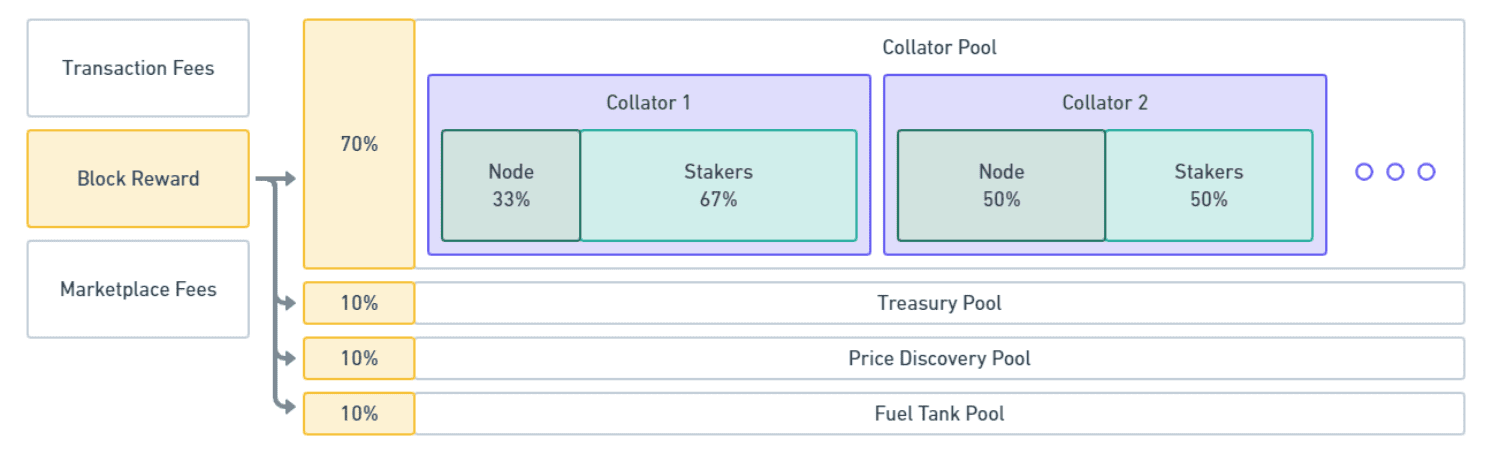
Ecosystem – 3% to the decentralized Treasury Pool on genesis. The remainder is unlocked monthly to the Ecosystem fund over 3 years.
Staking and Pools – 15% of the total EFI supply will be reserved for distribution to EFI pools as a Block Reward.
Community Sale on Coinlist
The public sale was held on Coinlist in June 2021
In under 3hrs $21m of $EFI sold on @$0.20 /token
Other funding: @Crypto.com
Going by the interest in this coin, I can only North upon release

Team
Enjin, the creators of Efinity have a large team of 95 employees, 19 of whom are experienced developers. It was founded in 2009 so it has over 13 years of experience in gaming, branching into NFT’s in recent years. Enjin has a large team of developers and advisors with ample experience and funding, They are experts in their field and their success to date is a true reflection of this.
Maxim Blagov (CEO, Co-Founder) – Visionary and creative director with 18 years of expertise in creative direction, software project management, marketing, and software design. Expert in concept & strategy development for large interactive applications, specializing in the Video Gaming and Blockchain industry.
Partners and Investors
Efinity has been funded by Enjin. Other high-end investors include Crypto.com and Coinlist
Roadmap
Efinitys Roadmap is divided into 3 phases, and it essentially incorporates all of the above thread
Coming up in 2021 Q4
➤ JumpNet smart contracts and ERC-1155 bridge
➤ Enjin Beam scaling and public access
➤ NFT.io marketplace
➤ Wallet 2.0
Conclusion
Efinity is bringing a lot to the world of gaming and NFT’s. Their entire ecosystem from their strong community to their unstoppable innovative team doesn’t seem to be slowing down anytime soon. Their new Paratoken standard and cross-chain interoperability will be of huge advantage to the gaming and NFT community. It will significantly increase liquidity and in my opinion, their feature-rich ecosystem will attract a lot of people to the space.
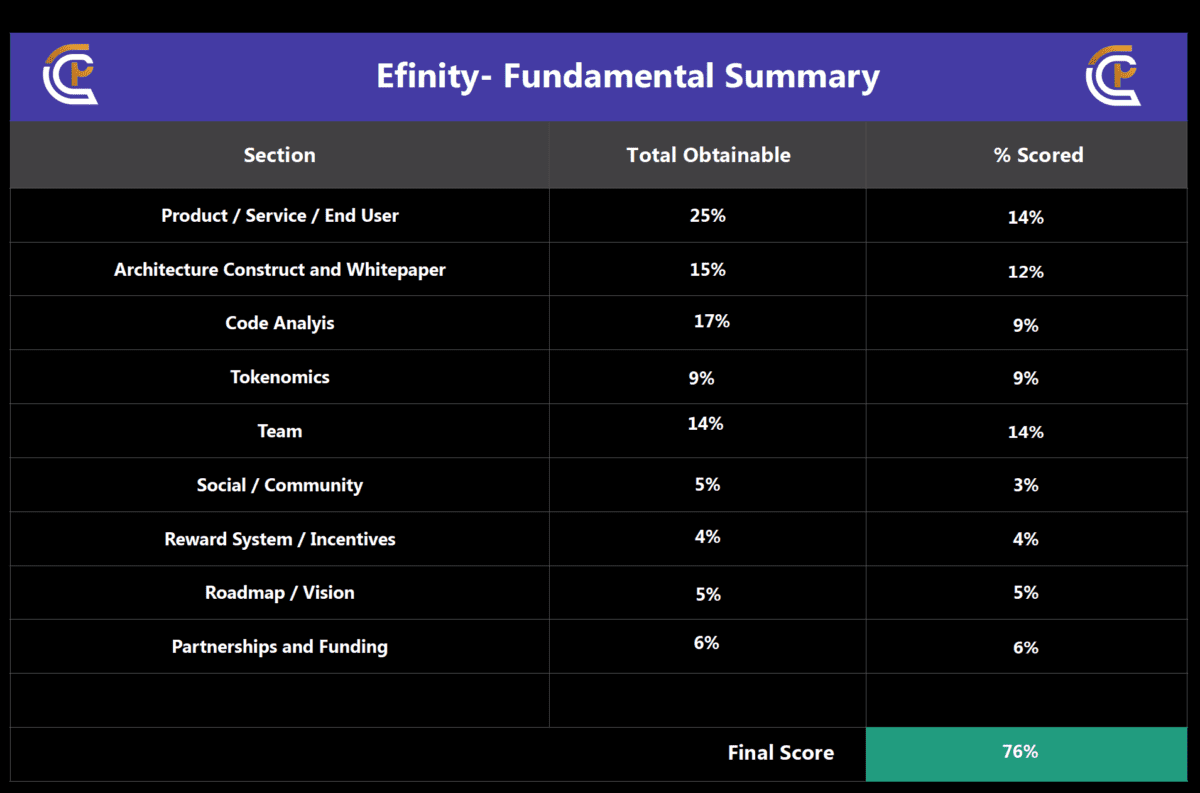
Please note that currently there is no working product is not available yet and the project code is not open-sourced. Once more information and updates are available, a new rating will be provided.
Resources
https://nft.io/
https://enjin.io/help/efi-to-jnet-guide
https://efinity.io/whitepaper/introduction
https://enjin.io/blog
Kilt Protocol
08/09/2021What Is Kilt
KILT Protocol, built on Parity’s Substrate, is an open-source blockchain identity protocol for issuing self-sovereign, anonymous, revocable, verifiable credentials and decentralized identifiers on Web 3.0. In addition, it provides the infrastructure that allows businesses and individuals to build on to monetize from the protocol’s features. KILT has recently won a Kusama Parachain auction. A significant milestone and one that proves the high-quality product that the team have delivered to date. Congratulations, KILT team.
KILT was developed by BOTLabs GmbH, founded by Ingo Rübe and the German publishing house Hubert Burda Media in Berlin, January 2018. KILT brings the old trust process in real-world credentials (passport, driving license, certificates, etc.) to the digital world, representing your identity while keeping your data private and in your possession.
The beauty behind the architecture is that your credentials can be validated without going through a central database. In addition, it is designed to be a fully decentralized permissionless blockchain network. That means that KILT is run for the community, by the community, with all decisions being made by KILT token owners.
Users can benefit from this by establishing their identity online without exposing their data to third parties. This could be registering for a website, platforms, social media sites, etc.

Value Proposition
➤ Self-Sovereign Data and Identity
Any entity can establish its own identity (without the consent of any other entity).
The Claimer is in control of their own Credentials
Users can choose which relevant Credentials to present to a specific Verifier
➤ Give everyday people a chance to control their own data in a trustless way
➤ Protection of user privacy
➤ Economy incentives for attesters to be trustworthy
➤ KILT provides a simple JavaScript SDK code that supports building applications without requiring any blockchain development skills.
What Issues is KILT Solving
➤ Currently, your personal data is at risk of malicious acts
➤ User data is stored in centralized silos, which is liable to hacker attacks
➤ Gathering and sharing of this data turns companies into powerful monopolies, which makes it extremely difficult for smaller companies to compete
➤ Exploitation of our personal data and identity
➤ Lack of accountability with personal data
➤ No decentralized trusted sources that can verify personal data
➤ Entities trusting other entities because of their status, their reputation, or just by definition
➤ Unable to trust entities with your personal data
How Does KILT Operate
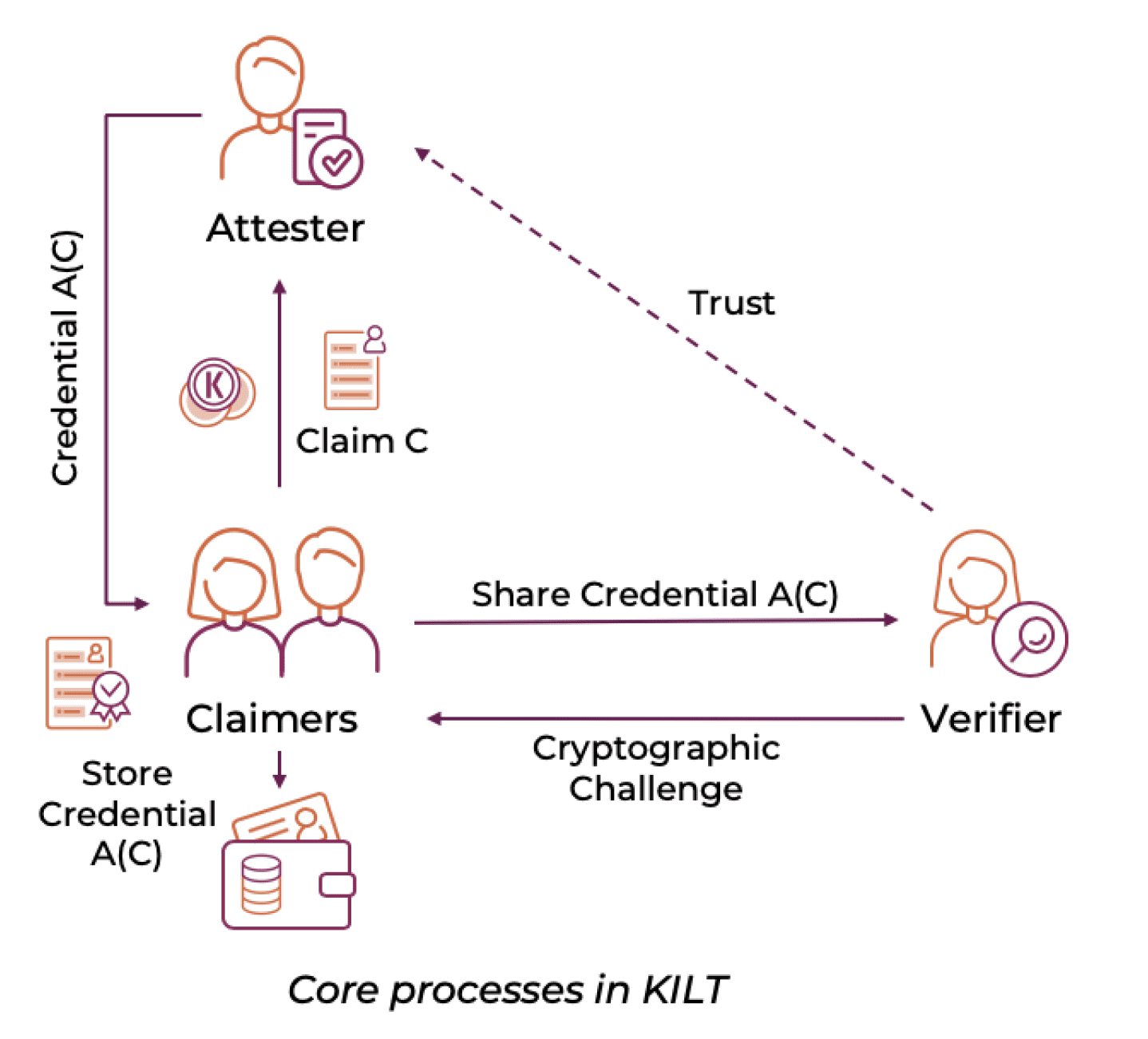
KILT protocol allows the Claimer (user) to claim any kind of characteristic about themselves to a trusted entity that we call an Attester. So what happens here is that if Bob wanted his identity to be confirmed, Bob, the Claimer, would send it to the Attester for verification.
If the Attester considers this claim to be valid, he can certify it. Then, he hands out the certificate to the Claimer (Bob) and stores a hash value of the certificate on the kilt blockchain. (Note that the user identity is not stored, only a hash value that represents Bob identity.)
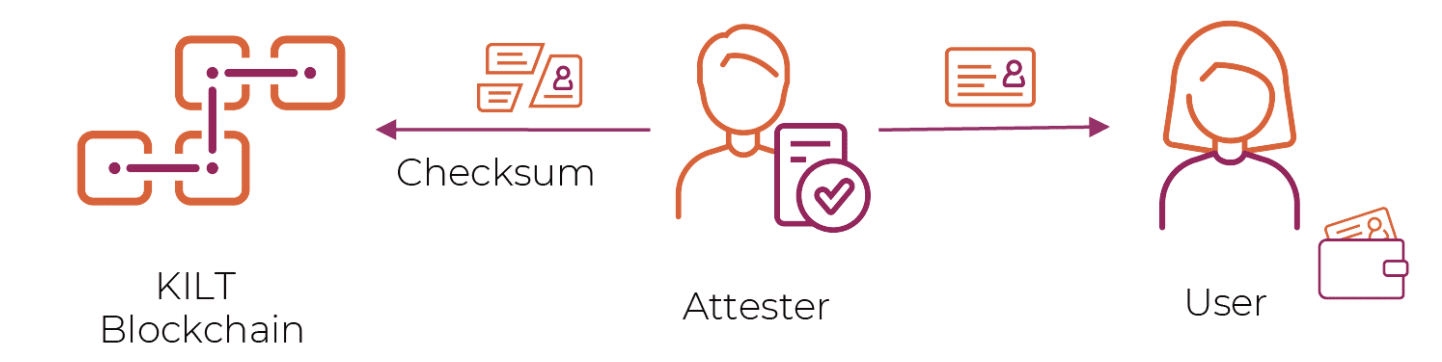
Once the Claimer (Bob) receives his certificate from the Attestor, he can present his credentials to the services he wants to use. These services may include site registration for any social sites, centralized or decentralized exchanges, Defi platforms, etc.

Before the Claimer (Bob) is allowed to use the services he is signing up for, the Verifier of that service will take Bob’s credentials and confirm it to the hash on the blockchain previously issued by the Attester.
This process is highly clever, as Bob holds complete control of his identity. Only a statement of validity (a blockchain hash) is stored on the blockchain.
Privacy Feature – When the Claimer (Bob) is showing his credentials to a Verifier, the Claimer can even hide all sensitive data that is not necessary for the verification. That’s how KILT protects the user’s privacy by design.
Revocable Credentials – If Bob’s credentials ever become invalid (e.g. expired driving license), the Attester can easily send out another hash of the certificate representing your driving license on the blockchain to show that it has been revoked. This is one of the key benefits why KILT Protocol use blockchain for their services.

https://medium.com/kilt-protocol/show-yourself-but-stay-hidden-45705158935
Where Can KILT Be Used
One of the fantastic things about KILT is that it can be implemented practically anywhere that requires a registration process or anything connected to the internet. As a result, users can hold and keep their identity private while still accessing their favorite sites. In addition, the convivence factor alone of not having to fill out online registration forms sounds like a dream come true.
KILT can directly benefit businesses to monetize and increase general efficiency and open new doors to products and features. Such businesses types include IoT, SaaS, Membership Models, AI, Cloud Environments, and Defi.
Please see below direct targets for KILT from a starting point:
➤ Government (DENA / German Ministry of Energy, and GAIA-X cloud storage)
➤ Gaming, eSports and “metaverses.”
➤ Carbon emissions
➤ Medical and genetics
➤ Academic credentials
➤ NFT’s
➤ Defi and DEX
KILT and Web 3 Foundation
KILT Protocol has received two separate grants from the W3F and has completed all milestones. Receiving a grant from W3F is an achievement alone, as only projects of high quality and potential will be accepted for the grant program. Furthermore, as the grant is paid out in milestones, W3F will stop the funding process if the code is not up to standard and does not comply with W3F terms and conditions.
Grant 1 – Revocable anonymous credentials solution
Grant 2 – Polimec: A Fundraising Mechanism for Projects within the Polkadot Ecosystem.
KILT plays a significant role with Web3. It gives the users back control over their identity. KILT will allow distributed entities (users, AI, smart contracts, machines, objects) to have an identity and disclose credentials among themselves. With decoupled attesters, the trust layer is abstracted, and new Web3 enabled business models can flourish in a trusted way.
Features and Benefits
KILT has an action-packed list of benefits and features. From speaking with the team, more information is still to be released for Token Curated-Attesters / Registry, Subtokens, Food Net, and many others.
➤ DID’s – Decentralized Identifiers
➤ Verifiable Credentials
➤ Self-Sovereign Identity ecosystem
➤ Claim Type (CTYPE)
➤ Polimec
➤ Portability across silos
➤ Sporran wallet
➤ SocialKYC
➤ Revocable Credentials
➤ Anonymous Credentials (with zk-Proof)
➤ Machine Identity
KILT Decentralized Identifier (DID)
A Decentralized Identifier – is simply a unique number that “identifies” your encrypted identity on the blockchain. KILT currently supports creating DIDs simply by using the address of the identity as the method-specific identifier, for example:
did:kilt:5GZ1ri8q2h7hXJHe9CnJVMAvGdRi3rbrrxfYBNHLwzH55daF
Your actual identity is then linked to this DID. An individual can add credentials (passport, driving license, SSN, birth cert, etc.) to this DID. These are then stored on the KILT Blockchain. This entry includes a signing key, an encryption key, and a link to the corresponding DID Document. It is important to note that when the identifier is registered on the blockchain, it becomes decentralized because the blockchain doesn’t store information in any one location; it’s spread across a network of computers.
Machine Identity – DID’s
DID’s also works for Machines, adding credentials for IoT devices, giving them a complete encrypted identity. This could be a credential, certificate or capabilities. And then, step by step, you add more and more credentials to that identifier, and then the device has an identity.
KILT SDK
The KILT SDK is a software development kit that uses JavaScript. The SDK makes KILT more accessible because big companies usually have some JavaScript developers, which allows them to use their own resources. Through the use of the KILT SDK, companies can build their project in just a few weeks. Incredible.

Self-Sovereign Identity Ecosystem
Self-sovereign simply means being in complete control of your own data. With KILT, the Claimer has full data sovereignty since they are the only owns of the certificate. It is impossible to restore the personal data from the hash; hacking the blockchain would be useless.
Claim Type (CTYPE)
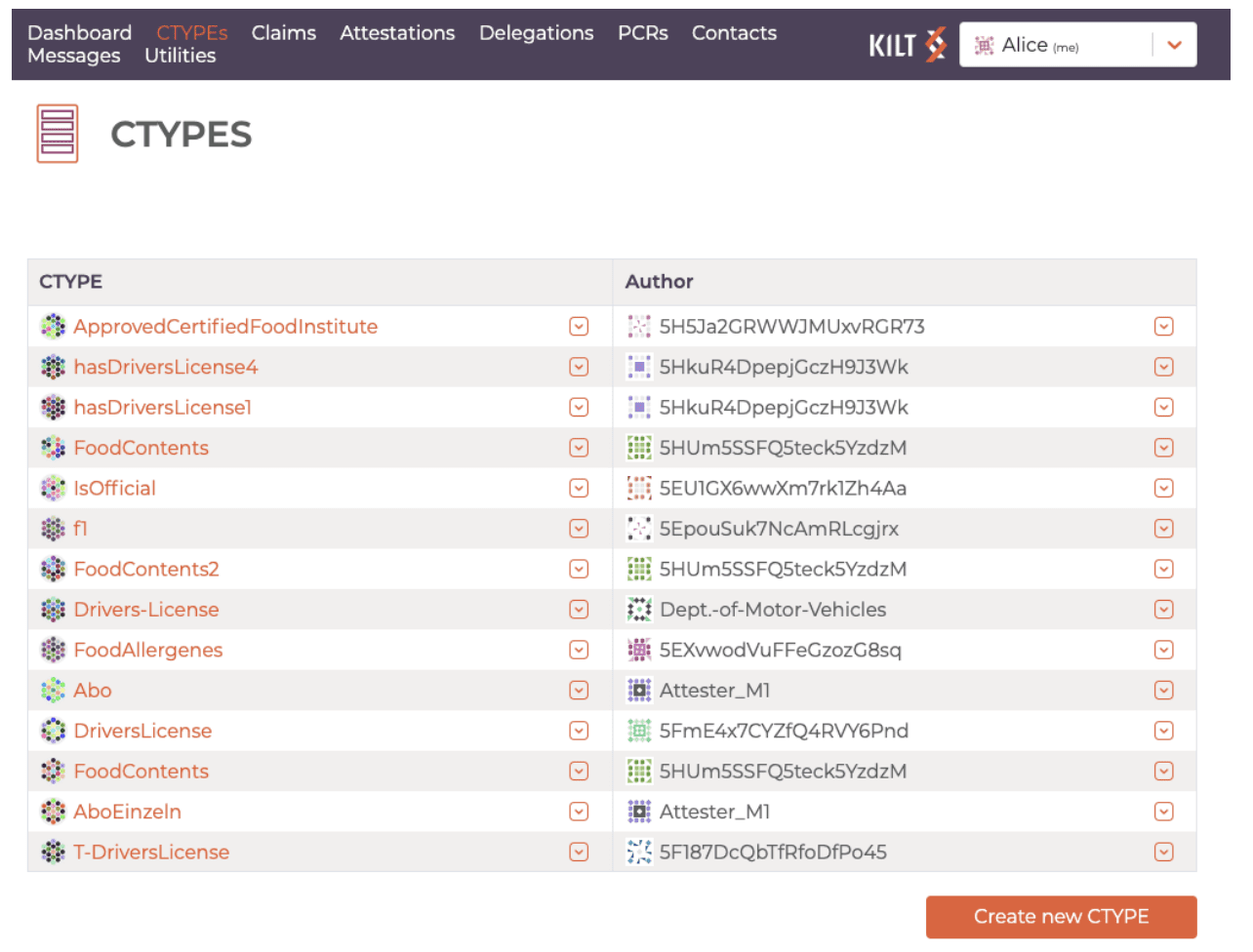
A Claim Type (CTYPE) is simply a template used by a Claimer to create a Claim on the KILT Protocol. Anyone can create a CTYPE, which can hold different credentials for various types of verification purposes. Adoption drives standardization of a specific CTYPE, so the more people use it and trust it, the more clout it has and users it will capture. In addition, the more valuable a CTYPE is, the more likely it is to be adopted by end-users.
Polimec
Polkadot Liquidity Mechanism (Polimec) is an open-source mechanism designed to help get liquidity into Polkadot based projects that are not yet ready to sell transferable currencies on their own technology. Polimec is a side project of KILT Protocol in which they received a grant from W3F. Essentially what Polimec does is help new Polkadot-based projects to issue transferable pre-coins before the launch of their mainnet. There is currently nothing like this available within the Polkadot ecosystem, only ERC20, until now. Polimec will utilize the KILT Protocol issuance, proof and verification of KYC/AML Credentials. Also, Polimec does not have a native currency, so maintainers are only rewarded in Gas fees paid in the currency transferred.

Sporran Wallet
➤ Sporran wallet will be available on mobile and browser extension
➤ It will show KILT Coin balances
➤ Signs and sends transactions on the KILT blockchain
➤ Ability to hold credentials and DID’s
➤ Add contacts by scanning their public identity as a QR Code
➤ Create Claims
➤ Transfer KILT Tokens
Download here:
https://chrome.google.com/webstore/detail/sporran/djdnajgjcbjhhbdblkegbcgodlkkfhcl/related?hl=en
SocialKYC
Individuals can use SocialKYC to identify themselves with internet credentials instead of traditional government credentials. The user’s identity is verified by proving control of their social accounts (LinkedIn, Twitter, TikTok, Discord, Github, etc.), email address or phone number. Unlike Web 2.0 sign-in processes, SocialKYC forgets about user credentials as soon as the certificate is issued. As a result, personal data is not stored, siloed or shared.
Gaming
Gaming is another top use case for SocialKYC and KILT verifiable credentials.
➤ Developing registries for pairing players and tracking awards
➤ Issuing educational credits and age verification for youth gaming
➤ Providing KYC for rewards and payment systems
➤ Tracking performance across multiple game platforms and networks.
Portability Across Silos
Portability across silos is a feature that will allow users to use the same credentials across different layers (services). An example of this would be if an e-commerce site wanted to accept Facebook as a sign-in method, then just open your Sporran/SocialKYC wallet and log in. It is as easy as that.
Anonymous Credentials
Anonymous credential is a type of digital Credentials in which entities can obtain from trusted Attesters (issuers) and show these Credentials to multiple Verifiers without necessarily revealing any identifiable information. So even if the Verifiers collude, they cannot pinpoint the identity of the Credential presenter.
https://medium.com/kilt-protocol/show-yourself-but-stay-hidden-45705158935
Token Utility
➤ Community governance
➤ Incentivize chain security/staking
➤ Fees associated with CTYPEs, Attestations, Revocations
➤ Fees for Private Curated Registry, Token Curated Attester
➤ Transaction fees (store & revoke credentials)
➤ Off-chain services

Incentives
Please see the list of known participant incentives below.
Please note that there is more information to be released regarding participant incentives.
➤Validator rewards
➤Delegator rewards
➤Attester rewards
User Security
➤ Only hashes are kept on the KILT blockchain, so the user holds their personal data. The risk of a data breach is significantly reduced
➤ There is no centralized data silo; everything is decentralized, less attractive to hackers
➤ The cost of hacking decentralized systems is considerably higher than that of centralized systems
Roadmap
KILT Protocol is planning integrations with Phala Network (privacy and cloud storage), Subsocial (decentralized social network), GameDAO and Bitcountry (Gaming and metaverse).
Please see roadmap in the image below for further detail’s

Tokenomics
Total Supply – Inflationary
Pre-mined coins at TGE – 150m (100m for community / 50m for BOTLabs)
Initial Circulation Supply – 34m
Very low inflation rate (starting at around 5% and falling to below 1% after 6 years)
Block distribution rewards are designed to decrease and end 50 years from the Mainnet launch gradually. KILT’s established ledger and trusted relationships will allow the chain to be managed by external systems when this time comes.


Team
Team Size – 25
Developers – 7
Advisors – 8 / Experience: Swarm Markets, Parity Technologies, Microsoft, BlockKore)
Founder and CEO
Ingo Rübe is the founder and CEO of BOTLabs, the company that develops KILT Protocol. As CTO of Hubert Burda Media, he initiated the open-source CMS Thunder, and he was previously IT Project Director at Axel Springer. Ingo is a founding member of the International Association for Trusted Blockchain Applications (INATBA) and served on the Board of Directors of the Drupal Association.
Vice President of Business Development
Christine Mohan has 25 years of experience in software and digital media, working for startups and corporates, including The New York Times and The Wall Street Journal. Previously she was CMO of Web3 Foundation / Polkadot and co-founder of Civil Media, a blockchain syndication platform.
Operations Director
Matthias has twenty years of professional and leadership experience in developing and shipping digital services for the internet and media industry. Since the early days of the internet, he has been managing front-end and back-end internet services for high traffic and scalable products.
Partnerships
➤ Botlabs GmbH – KILT development team
➤ Subscan – KILT’s blockchain explorer, built for Substrate-based networks.
➤ Polkadex and Fractal are implementing KILT for managing their KYC credentials
➤ Galaniprojects
➤ Dena – German Energy Agency
➤ DeBio Network – Anonymous-First Appchain for Medical and Bioinformatics Services & Data
➤ Federal Energy Agency
➤ GAIA-X – Data infrastructure: an open, transparent and secure digital ecosystem, where data and services can be made available, collated and shared in an environment of trust
➤ Degenics – blockchain-based, anonymous-first DNA testing platform
Conclusion
It may take some time for the masses to truly understand the importance of keeping their personal data secure and free from exploitation. For this reason, it may take some time for KILT Protocol to gain traction. However, KILT are definitely are in pole position due to their team, backing, robust architecture and secured parachain. I can only assume that their DAPP’s will be of high-quality UI/UX, easy to use.
There is a significant advantage for businesses and industry, in general, to take advantage of ILTt from the get-go. Not just for monetization benefits, but the protocol offers a significant advantage for businesses to earn their customers’ trust by allowing the Sporran/KYC extension for registration purposes.
Another major plus is that KILT has successfully won a Kusama Parachain slot and is backed by W3F. Additionally, KILT is pursuing a parachain slot on Polkadot. More information on this to come.
In my opinion, this is a fantastic project with a great team, and it will do exceptionally well. Moreover, they provide a high-value use case that is badly needed in today’s world. As always, getting into these projects is key, so don’t sleep on it! (not financial advice, just my opinion)

Resources
https://www.kilt.io/
https://medium.com/kilt-protocol/show-yourself-but-stay-hidden-45705158935
https://www.kilt.io/wp-content/uploads/2020/01/KILT-White-Paper-v2020-Jan-15.pdf
https://chrome.google.com/webstore/detail/sporran/djdnajgjcbjhhbdblkegbcgodlkkfhcl/related?hl=en
https://pedroporky.medium.com/kilt-partners-with-government-entities-gaia-x-germanys-federal-energy-agency-dena-29dbe1e751a5
RMRK
What Is It
RMRK is a standard for building NFTs on Kusama. It is a multi-chain NFT protocol that can be described as a set of rules for creating logic on a blockchain without built-in logic. The working operation of RMRK is discussed in more detail later, but for now, know that projects can leverage RMRK’s technology, providing a futuristic NFT experience to their users.
RMRK provides next-generation NFT technology where you can bring NFTs to life! Think of it as a number of NFT LEGOS that you can assemble, forming your ultimate NFT that can evolve and react to its surrounding ecosystem, making them even more unique and valuable.
An example of this would be – You hold a Bart Simpson figure NFT in your wallet. Imagine being able to add other NFTs (Barts skateboard, walkman, hair, glasses, slingshot, etc.) to that NFT! You can essentially build your own personalized version of Bart.
Now, instead of Bart sitting in your wallet gathering dust, you can give him utility. An example of this would be if a project launches a new game and you want to use Bart as a character in the game. Through RMRK’s genius technology, you can add multiple resources to Bart, one of which will allow him to have in-game utility. This is just a small taste of the exciting value that RMRK is bringing to the table.
What Is RMRK Solving
➤ NFT Marketplace Commissions inflicted on users.
➤ Interacting with NFTs is very expensive (buying, sending/receiving, etc.)
➤ Ethereum’s programmability and versatility is not capable of running RMRK’s unique functionality.
Value Proposition
➤ Unique NFT LEGO technology that is not available anywhere else.
➤ Adds long-lasting ever-evolving value to NFTs.
➤ Cross-chain interoperability through Kusama’s network.
➤ Cross-chain liquidity across NFT different marketplaces.
Under The Hood
Before we look at RMRK, let’s take a look at Kusama, where RMRK is running. Kusama’s architecture has a relay chain that connects all parachains, provides security, feature sharing, and many other functions. By design, Kusama does not allow logic to be written on it because little information or data is stored on the relay chain. Thus, if there is no logic, there is no NFTs on Kusama (without securing a parachain slot).
This is where RMRK’s remarkable technology comes into play. RMRK adds logic to the blockchain without on-chain logic. So how is this achieved? Substrate-based chains have a function called “remark” (where the name RMRK comes from). When arbitrary messages (NFTs) are sent to the chain, these messages are “remarked” onto the chain-blocks without changing the state or the chain’s values.
As described by RMRK, this is known as “graffiti” on Kusama’s chain–blocks. This allows them to write tools that know how to interpret this graffiti. The end result is NFTs and other programmable features on a logic-less blockchain. This, in turn, allows every project on Kusama the opportunity to interact with RMRK!
It is important to note that RMRK is currently working on a complete rewrite of RMRK logic using smart contracts (Solidity) for inclusion in EVM chains like Moonriver and FRAME Pallets (Substrate, Rust) for inclusion in chains’ native runtimes. This will make it so easy for projects on Kusama to implement RMRK and take advantage of their unique technology. This is planned as part of RMRK 3.0, which is scheduled for Q1 2022. Very exciting times ahead for RMRK.
RMRK & Statemine
Statemine (Statemint on Polkadot) is a permissionless Common-Good-Parachain. Statemine is designed to be the canonical balance-keeper of thousands of different fungible and non-fungible tokens. RMRK utilized Statemine for the launching of the RMRK token and it was the first Statemine asset to be listed on a centralized exchange!
How Can Users Interact With RMRK’s Technology?
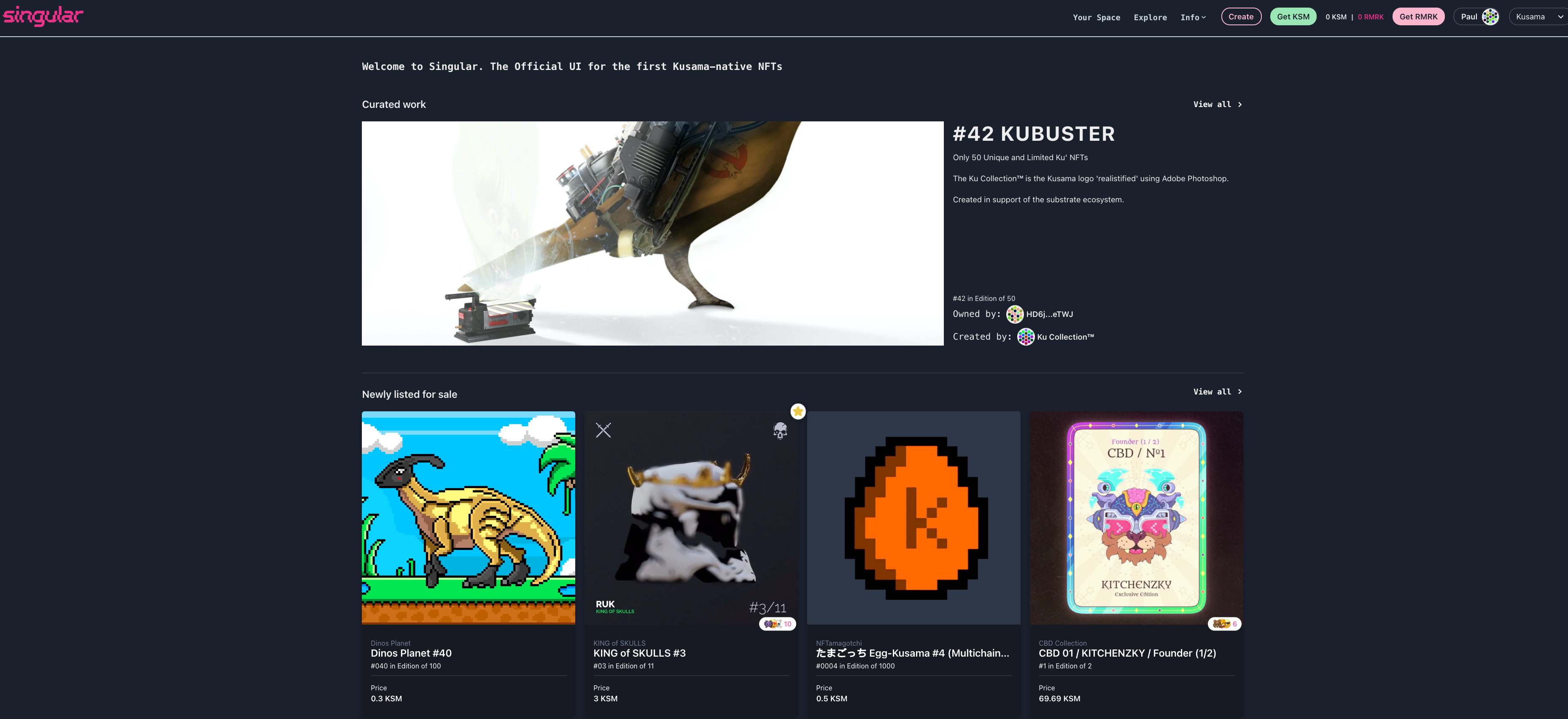
Currently, there are two places where users can interact with RMRK’s technology, Kanaria, and Singular. Below is an introduction to Kanaria and Singular. However, RMRK’s cool features will be discussed later in the article. Both these are 100% owned and created by RMRK. You can connect to both app’s by using the polkadot.js.org/extension.
Singular
Created in May 2021, Singular is RMRK’s open NFT marketplace for official minting and trading UI for Kusama-native NFTs. Singular is currently running off RMRK1.0 protocols. However, the RMRK2.0 protocol is active and running smoothly on Kanaria. Once matured, RMRK2.0 will be migrated to Singular, where the users can also avail of RMRK true functionality.
Singular supports Statemine’s Common Good Parachain, but unlike Kanaria, it only supports primitive NFTs with little functionality.
Kanaria

Fundraiser
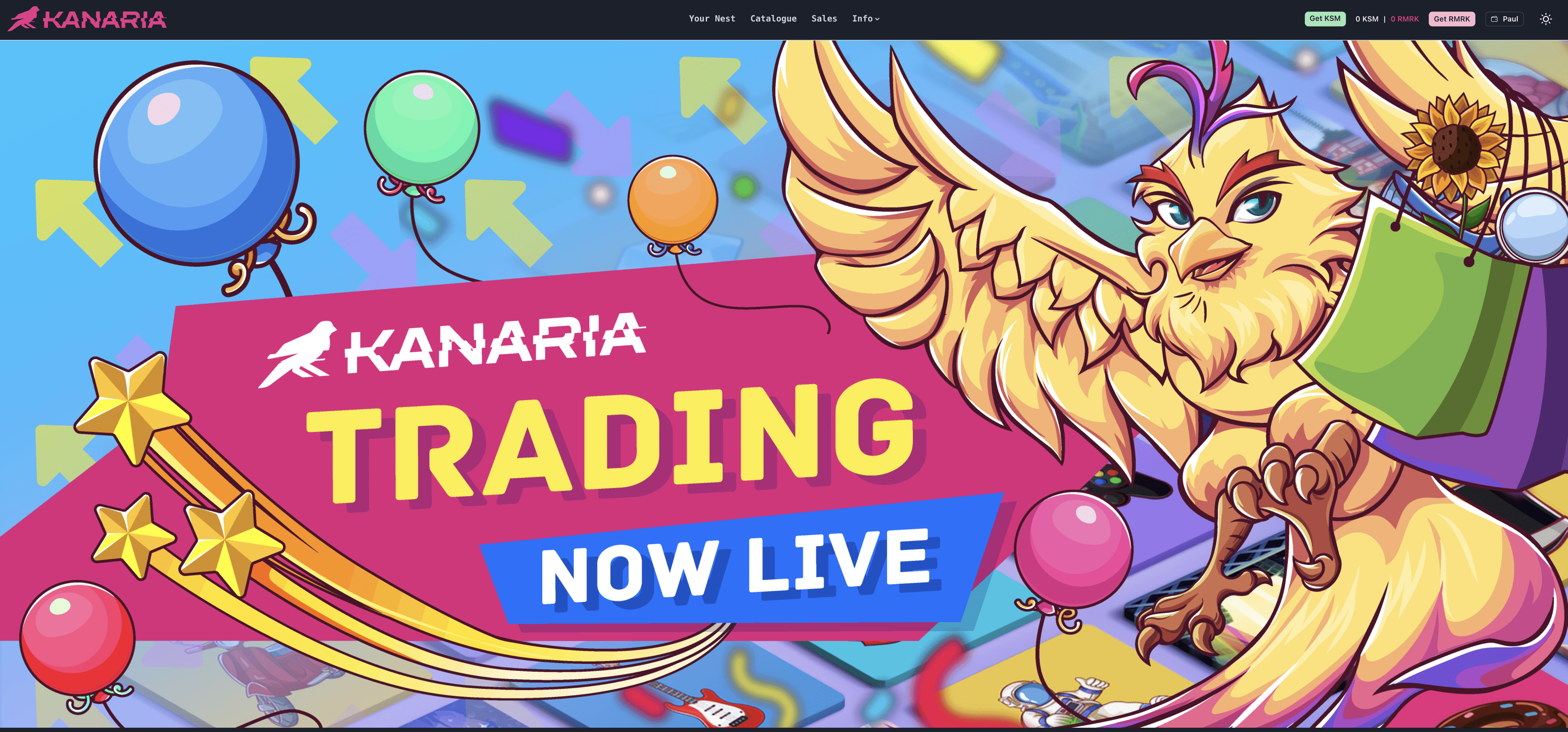
Hosted on Kusama, Kanaria is the world’s first NFT Launchpad framework using the RMRK standard. Kanaria was a fundraiser for the RMRK Association. The fundraiser consisted of 9999 unique NFT eggs that hatched into unique and rare Kanaria birds (canaries) with special upgradable traits. There were only 8861 eggs out of 9999 birds claimed. With the current prices these birds are selling for, I am sure there are many people sorry that they missed it (including myself).
Everyone who claimed an egg automatically qualified for the Fairdrop in which a quantity of RMRK tokens was airdropped to the egg holders. The number of RMRK tokens you received depended on the classification of egg you purchased with KSM. Please see below egg classification with the number of associated RMRK tokens.
Super Founder: 32362 – RMRK tokens
Founder: 21574 – RMRK tokens
Rare: 4314 – RMRK tokens
Limited Edition: 431 – RMRK tokens
Kanaria
Browse through the catalog of birds for sale and filter through classifications from Super Founder being the rarest down to Limited Edition (as listed above). Users can also view the recent sales, birds for sale and see all the assets they hold in their nest on the Kanaria platform. Currently, KSM is used for general transaction fees for both Kanaria and Singular. However, the RMRK token is planned as a fee payment also.

Features
This is where we will see the true functionality and value that RMRK provides both projects and users. Each of the features (NFT LEGOS) below can be used independently or altogether.
Multi-Resource NFTs
NFTs have the potential to be many different things in parallel. RMRK’s multi-resource NFTs, enable a single NFT to have multiple different outputs. Users can essentially customize their NFT to have many utilities such as; speaking, singing, or a high-resolution image, depending on which platform they are uploaded on. The beauty about this is that you can add additional resources to NFTs long after they have been minted. This gives future-proofing to the NFTs.
Fall back resources for NFTs –are to prevent rug-pulls from destroying your NFT art. You can store your NFTs on multiple different centralized and decentralized storage services, so if your NFT someday disappears on one storage device, you will still have access to it on another.

Nested NFTs
Just like Bart Simpson’s example earlier on, NFT can own other NFTs. In addition, the NFTs can equip other NFTs to change their output media. So let’s check out the Kanaria Birds, where RMRK has showcased this exceptionally well.
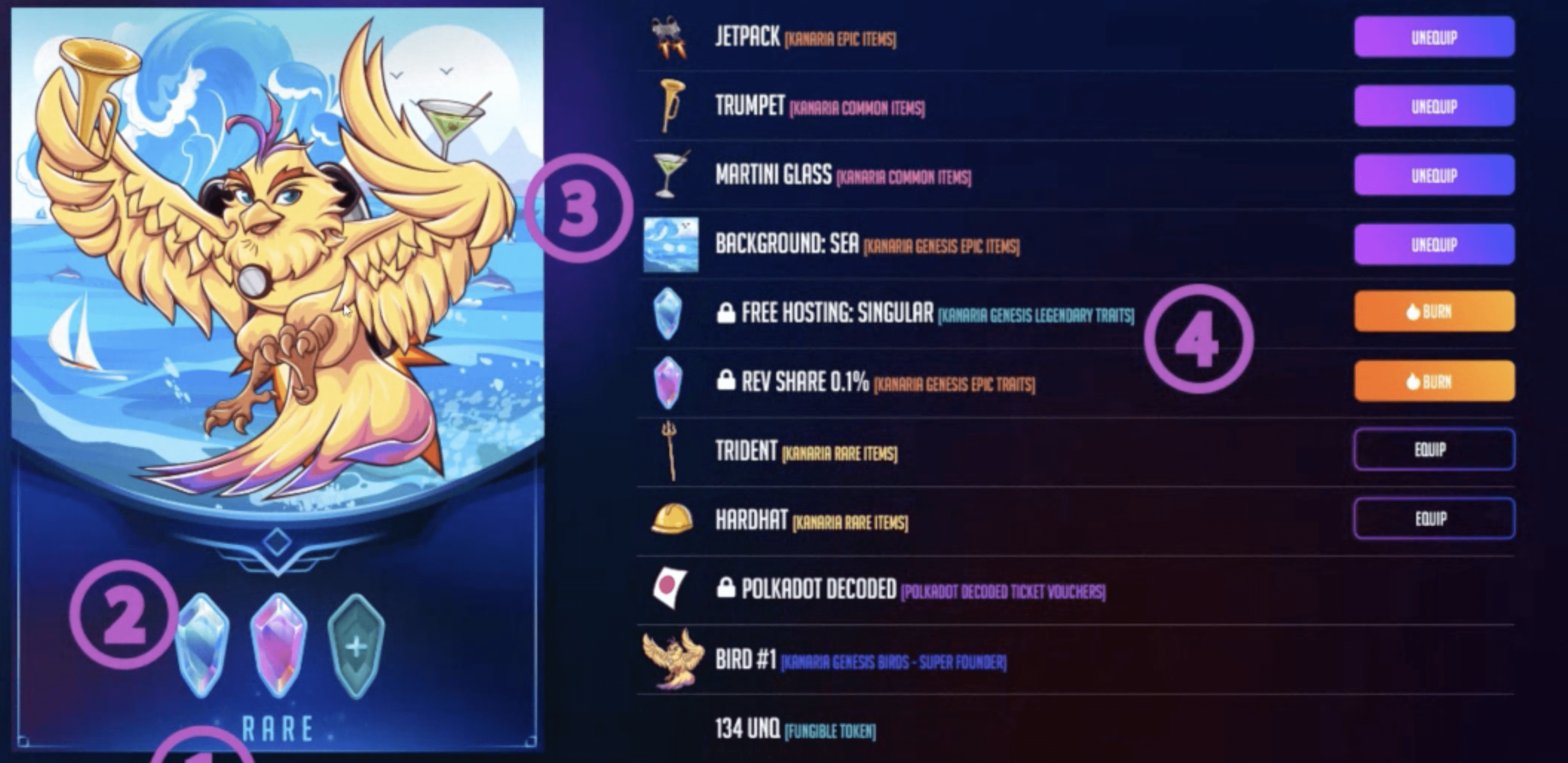
Shown below is a Kanaria bird, one of the Super Founder birds who owns several items; jetpack, ears/nose, and a background. When the main NFT is opened, you can see all the other NFTs (items and gems) associated with that NFT. The user has the option to equip or unequip these items to the bird. This is super cool as you can dynamically change the appearance of the bird in real-time. The items can be sent/sold to other users, and they can equip it to their bird if they choose to do so. When loading your birds on Kanaria, you can see each element (feature) of each NFT load independently – this is the first time in history this has been done.
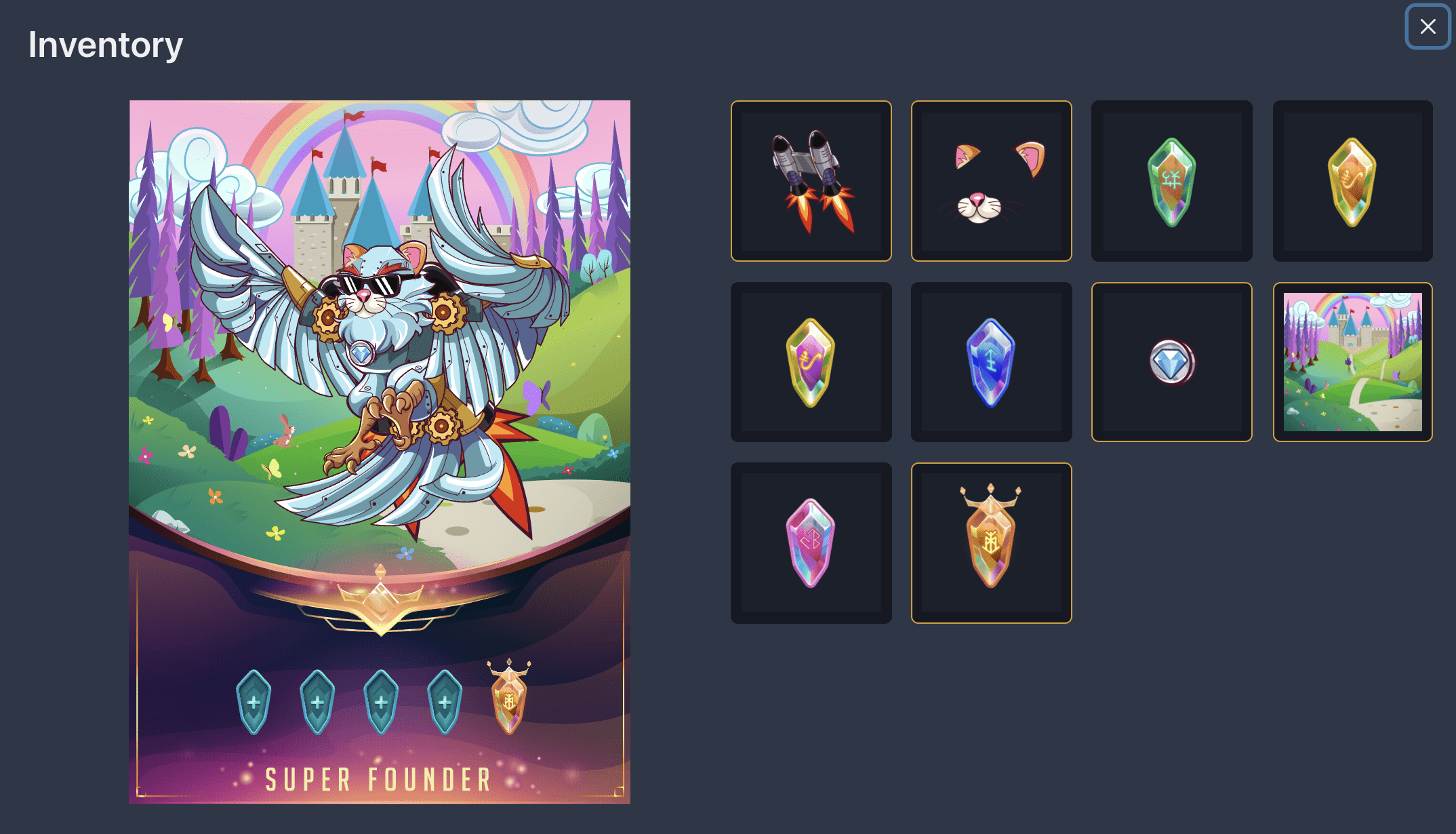
In the image above, you can also see several GEMS. The gems cannot be sold or transferred but can be burned, equipped, or unequipped by the owner. There are different Gems associated with each Bird and each Gen as its own functionality. Shown below are some of the gem traits related to the bird above.
Daikoku – “This trait removes the commission otherwise charged on the Singular market in perpetuity.”
Legendary Trait Voucher – “This trait allows the owner to burn it as a fee to buy a legendary trait or a trait of a lower order from RMRK.”
Epic Trait Voucher – “This trait allows the owner to burn it as a fee to buy an epic trait or a trait of a lower order from RMRK.”
Forward Compatibility
Forward Compatibility (which works in conjunction with resources) simply means that NFTs can have various outputs depending on their utilization conditions. Resouces can add different outputs to NFTs that enable them to be multi-compatible under different environments. For example, let’s say a user had an NFT of game character – one resource could be a 2D model and the other a 3D model, both of which could be utilized. Another example could be an ebook, where one resource, “compatibility,” could be a pdf while another could be an audio file. This is super cool as it provides additional utility to your NFTs that could be used on an array of different games, platforms, projects, marketplaces, etc. How it works is the issuer of the NFT collection can propose new resources to its holders. The NFT holders then have the option to accept the new proposed resource. Once accepted, their NFT can be upgraded.
On-Chain Emotions
In simple terms, on-chain emotions work by sending emojis (selected from the emoji keyboard) to NFTs on the RMRK system. Any person viewing that NFT can then see the different emoticon reactions on that NFT.
On-chain emotions can have multiple powerful uses.
➤ Gamification and social mechanic – general social fun and interaction
➤ Early price discovery – Let’s say if one NFT starts attracting a lot of attention in the form of emotes, you can quickly gauge if it may be worth more than the other NFTs
➤ Emoji Bots – An emoji bot can be implemented to analyze a particular person to see what NFTs they are reacting to. This is super cool because you can analyze what NFTs, high-profile individuals are liking.
➤ Consume function – Early influence of evolving NFTs (e.g., an unhatched bird egg). Users can send emojis to particular NFTs that can influence the traits of the NFT!
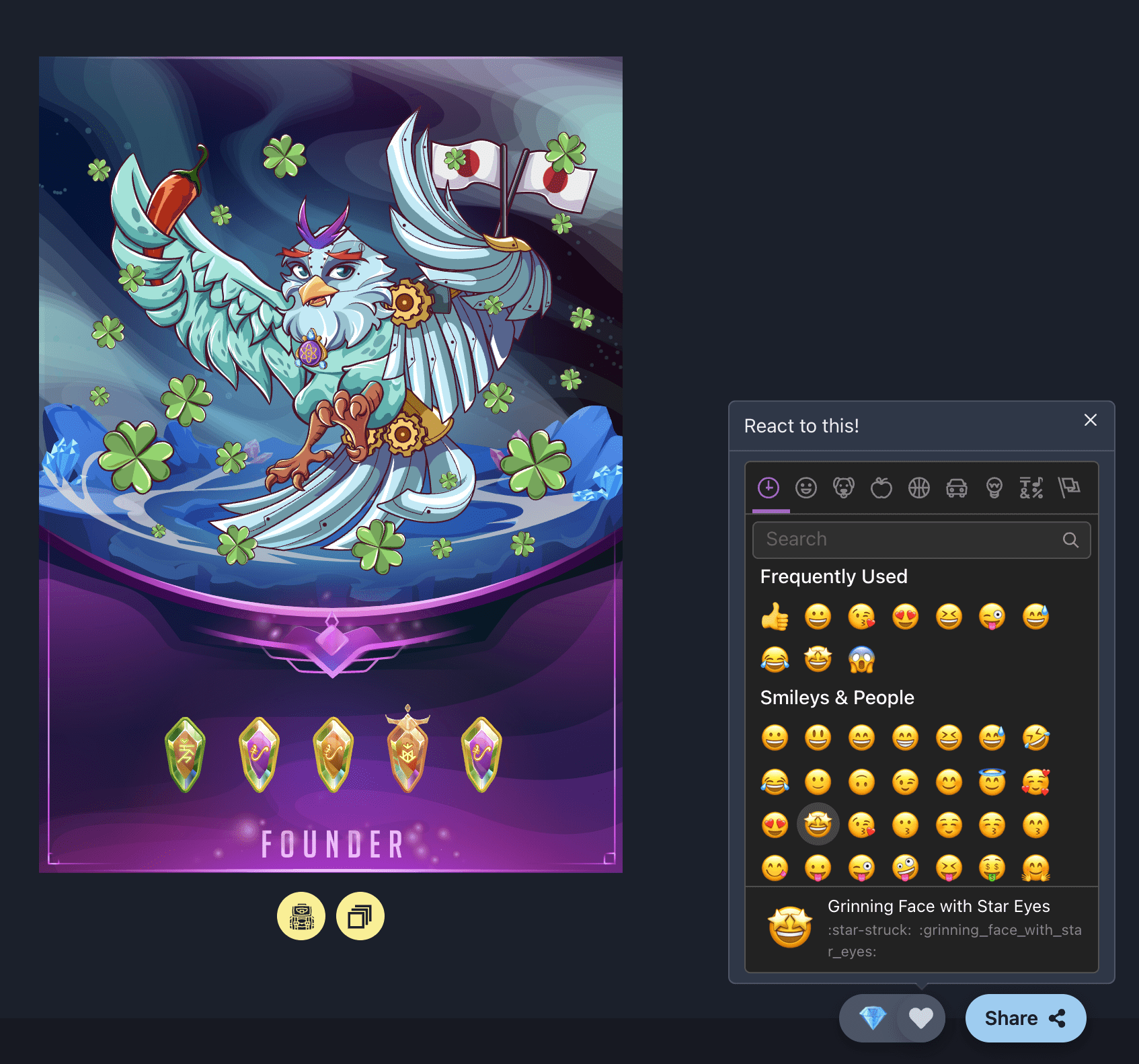
On the Kanaria platform, users can view which accounts reacted to specific NFTs and which emojis they reacted with. Please see the image below.
Conditional Rendering
Apply simple logic (parameters) to your NFT so that you or other users can change its appearance! An NFT can be rendered, depending on a specific condition (on or off-chain) that can be specified by the owner. For example, let’s say you (the NFT owner) have an NFT of a lady walking her dog home. While the NFT is visible to other people, you can change an item of clothing or the color of the sky by pressing a button in your wallet. You could also have these rendering changes triggered by other conditions, such as when it hits a specific date or time or KSM hits a certain block number.
Another way to render the NFT would be to incorporate on-chain emotions and multi-resource NFTs. For example, if you have Chucky doll NFTs, one as a static high-resolution image of Chucky and the other with Chucky speaking. Then, you can apply simple logic to your NFT: if Chucky got 50 scary emojis, the static Chucky NFT would automatically switch to the other resource NFT of Chucky speaking!
NFTs as DAO’s
NFTs will have the potential to be broken up (into fungible tokens), which in turn, will form a DAO (community ownership) for that particular NFT. These tokens can then be used to govern the NFT in-game functions. For example, an in-game user buys a movie theatre and breaks it into ten segments (fungible tokens). These tokens are then sold to other in-game users forming a DAO. The DAO decides what movies are shown at the movie theater and gets royalties from the showings. Note: NFTs as DAO will become available with RMRK 3 and the transition to pallets and smart contracts.
Metaverse
RMRK is developing a Metaverse that sounds completely mind-blowing. It intends to incorporate the famous Kanaria Birds and a multiple range of features, some of which are listed below.
➤ Use your Birds as avatars.
➤ Grow the birds and teach them experiences.
➤ Stats Cards – RMRK will add “stats cards” that contain a written “back story” for your Bird. This stats card will have specific stats. If you accept the stats card, then it will be sent directly to your bird. You then can upgrade your stats by participating in events.
➤ Staking your Bird to mine base resources. Base resources are components in which you can craft other items.
➤ Collect recipes, so you can craft them for money, for other people, or just craft them for yourself.
➤ Equip the crafted items to your bird and deck them out further for better in-game experiences and environments. This may allow you to participate in other quests or organizations.
➤ Buy in-game NFTs, fractionalize NFTs, create DAO’s, governance voting, earn rewards (check out the video below).
Token Utility / Rewards
The RMRK token has several utilities. Please see below.
➤ Liquidity – Used for providing liquidity on CEX’s.
➤ Defi – RMRK token will be usable as stablecoin collateral on platforms like Karura / Acala.
➤ Cross-Chain Interoperability – Connection with NFT Marketplaces on other chains to perform basic features such as buy, sell, mint, trade.
➤ Governance – of multiple platform features (mentioned above). With over 88% of all tokens allocated to protocol users, the RMRK Association’s token supply is fully decentralized and ready for community governance.
Stake RMRK token in the following ways to earn rewards
➤ DAO Collateral – staking RMRK will allow the user to essentially convert an NFT (e.g., in-game item) into fungible tokens that can be sold off, creating a DAO. The DAO can then govern that specific NFT and get rewarded in doing so.
➤ Whitelabel Campaigns – Commission fees for any whitelabel copying of the Kanaria initial collection will be taken in RMRK
➤ Deflationary Mechanism – TBD – “To report someone, you have to stake RMRK tokens. The winning party obtains a fraction of the opponent’s stake, and the rest is burned, reducing the supply.”
➤ Curation In Galleries – Stake RMRK to mint an NFT on Singular
➤ Verified Artist – A minimum of 10 RMRK tokens need to be in your wallet if you want to start the process of becoming a verified artist. If you are successful, you need to maintain a balance of 10 RMRK, or you will lose your verified status checkmark.
Metaverse Staking – in the planned Metaverse, you can stake your $RMRK to:
➤ Mine raw materials (fungible tokens) from your land
➤ Craft new items for the Kanaria birds using your raw materials
➤ Stake the birds & RMRK to generate performance boost’s for the Kanaria birds
Tokenomics
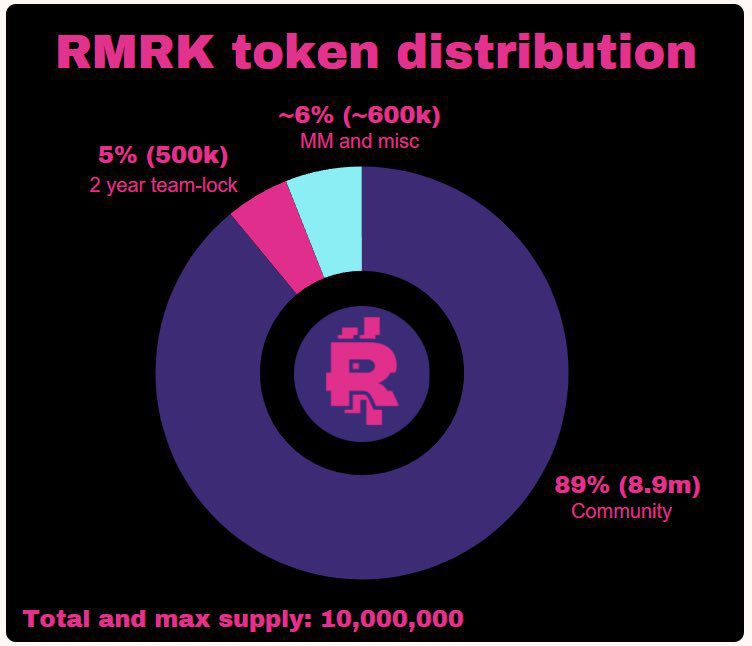
Maximum supply: 10 million
Supply is Deflationary by design
Current Circulating Supply: 8.8 million
Team Allocation: 5% (500,000 tokens)
Remaining Token: Liquidity for CEX’s
Vesting
Team tokens: 5% is locked for the team to access after two years (1-year cliff, one-year linear vesting per block)
Team
Total Team Members – 10
Developers – 3
Team Experience – Web 3 Foundation, Blockada.io, Bitfalls, Vivax Communications
Bruno Skvorc – (Founder)
Yuri Petusko – (CTO, Co-founder)
Yuri G. – (Co-founder)
Ilia – (Co-founder)

Roadmap
Please see the list of features and innovations that RMRK has planned. Some of these are a part of RMRK 3.0.
➤ Full rewrite of RMRK logic using smart contracts (Solidity) for inclusion in EVM chains like Moonriver and FRAME Pallets (Substrate, Rust) for inclusion in chains’ native runtimes.
➤ Metaverse
➤ Singular – RMRK 2.0 features incorporated – (Nested NFTs, Multi-Resource NFTs, Conditional Rendering, NFT as DAO’s)
➤ Avatars, Banners – Rich profiles on Singular and Kanaria
➤ Platform Bonuses – through RMRK partnerships – (depending on if you hold an item of that specific company in your wallet)
➤ Grants – There will be a grants program panned where RMRK will be giving grants to teams to build stuff for RMRK
➤ Community Events – RMRK will be organizing community events where participants will be able to contribute art and community-contributed items – more details on this to be announced
➤ Auction house (auction candle type)
➤ RMRK Torrent Tracker
➤ RMRK Curated Lists
Partnerships
RMRK has a lot of partnerships in the pipeline. Shown below are the one’s currently public.
Current Partnerships
➤ Khala Network
➤ Unique Network
➤ Promoteam
➤ Zeitgeist
➤ Unifty
➤ Bifrost
Pending Partnerships
➤ Karura
➤ Bit.Country
➤ Shiden
➤ Altair
Investors
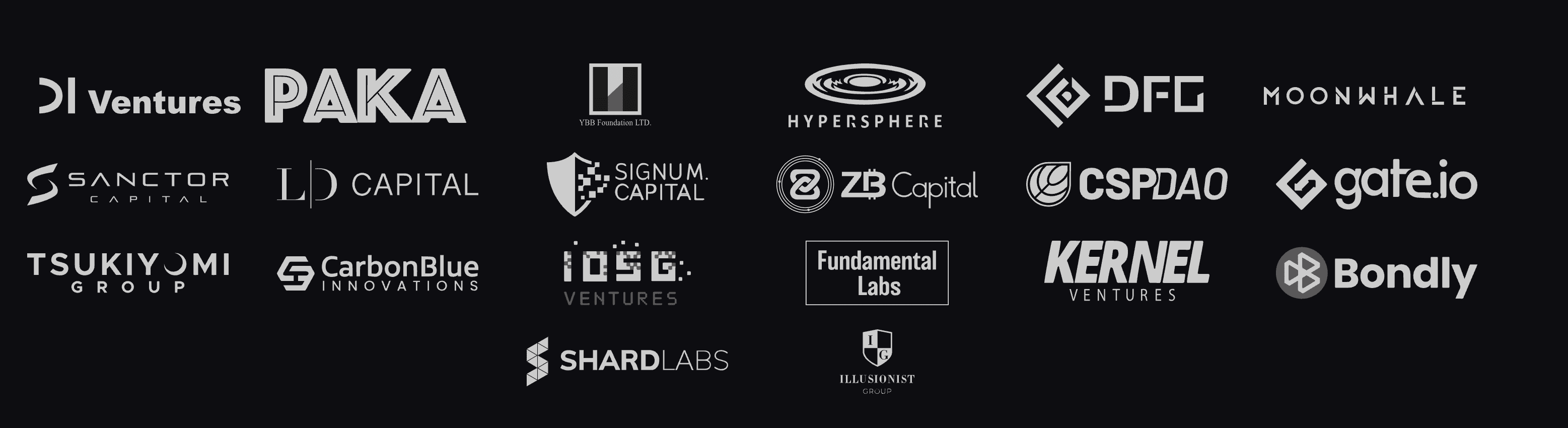
Several investors participated during the fundraising round, purchasing Kanaria eggs at the same price as the community. However, some investors chose not to collect eggs which was great because they went into the RMRK NFT Treasury. Please see the below image of investors that took part in the community fundraiser.
Verdict
I would consider RMRK the most advanced NFT protocol in the world with extremely high potential. RMRK provides unique futuristic features to NFTs, taking them to the next level. RMRK’s technology allows users to take their NFTs and essentially give them meaning and useability. Features such as nested NFTs, forward compatibility, emotions, multi-resource, and create DAO’s are the future of NFTs. NFT Artwork is lovely, but is it not more fun and rewarding to bring that artwork to life! As RMRK NFTs evolve with the protocol they are built on, they can easily be utilized in any NFT game, Metaverse, or marketplace. This makes them even more unique and valuable as time grows.
RMRK has a small team of 10 people, but the team is effective and efficient with very admirable experience. They are knocking out feature after feature without any resistance and will continue to do so.
I believe that once RMRK implements the protocol for use through EVM chains and FRAME pallets, it will see a burst of partnerships and explosive growth. In addition, RMRK intends to be made available on the Polkadot ecosystem and all its parachains. RMRK has very attractive tokenomics. A very low max supply at 10m and a high proportion of the supply is community-owned.
Please see my rating for this project below.

Resources
https://www.rmrk.app/
https://kanaria.rmrk.app/
https://singular.rmrk.app/
https://www.crowdcast.io/e/rmrkintro/register
https://github.com/rmrk-team/rmrk-spec
https://discord.com/invite/esuzUr3eAM
https://app.subsocial.network/@rmrkapp
https://docs.google.com/document/d/e/2PACX-1vToDf7FmFbNwnIvXJeCvWvXscG7HwL638eeuAlV3-692vExzpzoHJNAmqc-jEu2IeOEyYgJuN_Fn4th/pub
Hathor Network
07/09/2021What Is Hathor
Hathor Network was created to provide a simplified blockchain framework suitable for developers and end-users while being fast, cheap, and scalable.
Hathor provides the infrastructure for new and existing crypto projects to build on. However, this is like no ordinary infrastructure project. Hathor’s unique architecture design allows for instant transactions fees at zero cost. The more the chain grows (more projects added), the faster the transactions!
Hathor Network is a hybrid blockchain. Hathor reaches consensus by utilizing two consensus methods; Directed Acyclic Graph (DAG) (e.g. IOTA) with Proof-of-Work (PoW) (e.g. BTC). In other words, it is a SUPER CHAIN!
Under the Hood
Hathor’s source code is developed from scratch, using DAG and blockchain technologies intertwined in their ledger. When there is a low amount of users on the network, Hathor uses a system called merged mining, in which they utilize Bitcoin miners (PoW) to verify HTR transactions. The Bitcoin miners are rewarded in native HTR coins. When a certain amount of users on the Hathor network are reached, DAG technology will kick in, and the BTC miners will no longer be needed. In addition, new transactions will verify previous transactions, so essentially a high quantity of network transactions will make the network faster as they all will be verifying each other!

What Is Hathor Solving
➤ Scalability Issues – because of Hathors DAG technology, increased users equal faster transactions. In addition, with Hathor, there is no central coordinator or any single point of failure.
➤ High Transaction Costs – Hathor provides free and instant transaction fees
➤ Non-IT Proficient – Through Hathors Tokenization and Nano Contracts features, users with no IT skills can configure Smart Contracts and create their own tokenized assets with little effort.
HTR/FDT
It is important to note that there is an independent team of infrastructure developers named HTR/FDT that continues to build and add value to Hathor’s ecosystem. They are responsible for a lot of the fantastic features listed below.
Features
Tokenized Assets – Create your own tokenized assets on Hathor chain in less than 60 seconds. Imagine someone who knows nothing about coding to be able to create their own cryptocurrency. This cryptocurrency could be used for various applications in small to large businesses, loyalty reward programs, or just for fun! This is a real game-changer. The 1% minting fee (in HTR) for asset tokenization is removed from circulation, increasing demand!
Run full nodes with a few clicks and start building DAPPS! Hathors partnership with $ANKR makes it super easy for anyone to deploy their own node with just a few clicks and then start mining and building DAPPS!
Hathor Green – Incentive program rewards miners with HTR coins every time they prove the use of renewable energy on their Bitcoin and HTR merged mining operations. This is a step forward Hathor is taking towards an eco-friendly cryptocurrency industry
Zero Transaction Fees – Hathors merged mining & DAG technology allow users to enjoy instant zero transaction fees.
Unity Game Engine – Developers can now integrate Unity Game Engine plugin with Hathor
➤ The plugin enables game developers to integrate their creations with Hathor Network for in-game micro-transactions
➤ MASSIVE news for HTR and gamers combined, and it is only the beginning
NFT Platform – Hathor already has their first NFT platform built on the Hathor Network called @9Blocks!
Imagine creating your own custom NFT token on Hathors NANO Contract tech and using it inside gaming as gold coin, clothing, weapons, etc
Native Wallet – Hathor have their own native wallet, and it is available to down for Mac, IOS, Google Play, Windows and Linux.

HathorPay Chrome Ext
➤ Send/receive HTR & custom tokens instantly with zero fees on HathorPay
➤ Use your wallet as a cryptographic login process on future Dapps built with HathorPay
➤ It aims to have a built-in fiat on-ramp by the end of the year via a third-party provider
Woocommerce checkout plugin / Virtual Debit Card System
➤ Vendors can set up HTR payments through the HTR Woocommerce Plugin, which will allow customers to make payments with their HTR virtual debit card
➤ It is estimated that there are 4.4m Woo sites out there – if Hathor even reached 1% of them, that’s roughly 44k VENDORS
➤ Huge demand will be created
Airdrop Management Tool – HTR/FDT is in the process of developing an Airdrop Management Tool where you can send your custom generated tokens to selected participants
➤ Send mass airdrops to anyone or everyone in your HTR wallet
➤ Create specific airdrop lists
Whale Room – HTR/FDT has developed a social interaction platform for cryptocurrency whales where you can join with a minimum of “X” amount of HTR (depending on the project). It aims to provide trusted information from a reliable source to reducing market dumps due to flawed information
HathorSwap – Hathor is building their own Decentralized Exchanged (DEX) called #HathorSwap
Try to imagine a DEX with the following:
➤ Instant zero transaction fees
➤ Running on the world’s fastest, reliable and robust database, “Amazon Quantum Ledger Database (QLDB)
➤ No scalability issues
Hathor Community Faucet – developed by a community member, Faucet is software in which you can enter your HTR address and receive a small amount of HTR! This allows users to witness the true speed of the Hathor Network and get some free HTR in doing so.
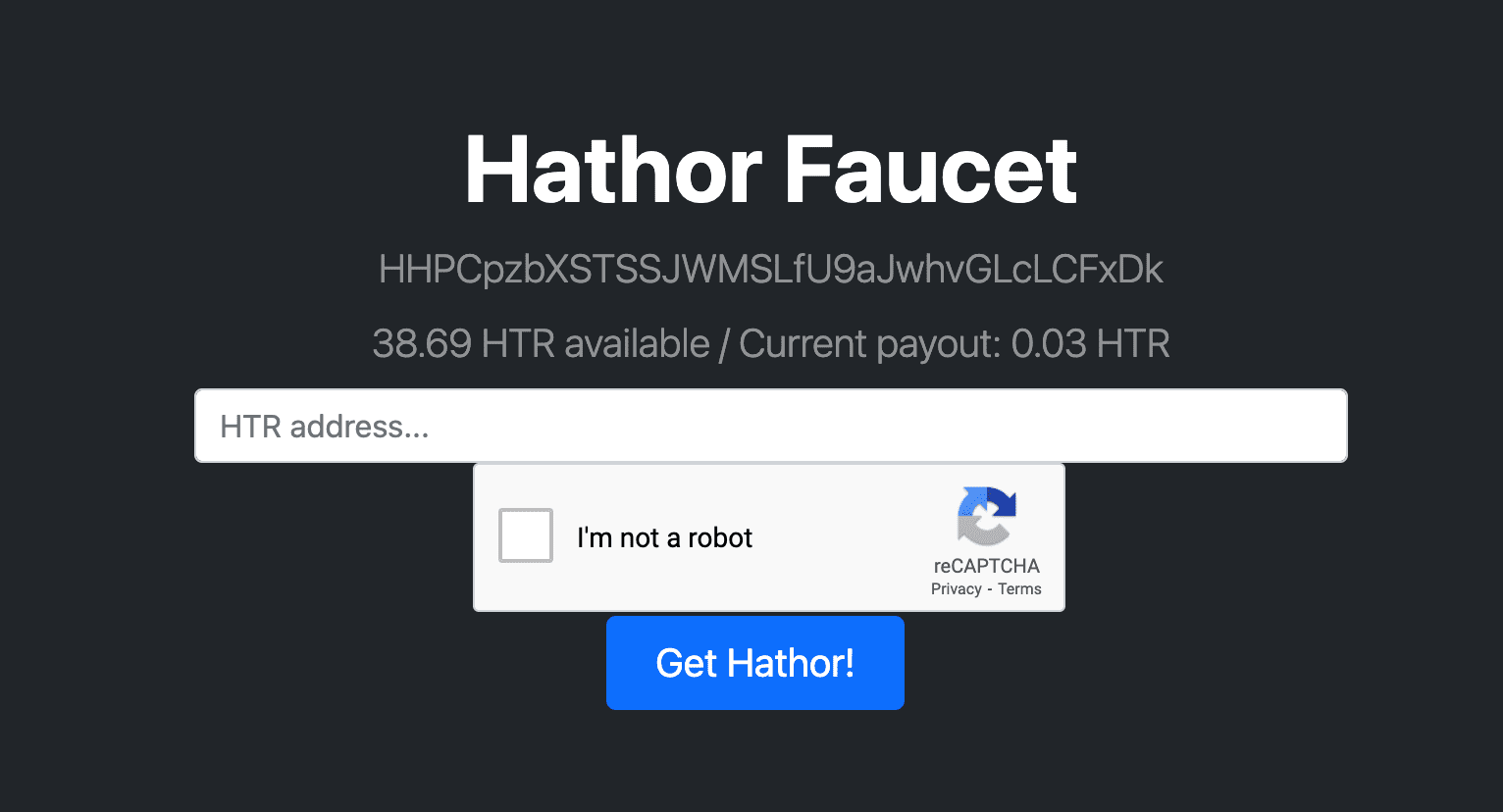
Hathor Club is a fantastic feature that allows users to convert their ETH in HTR on the Hathor Network. This is done by swapping ETH for hETH (Hathor ETH) and then into HTR. Then, using the “melt’ feature, this can be exchanged back into ETH at any time.
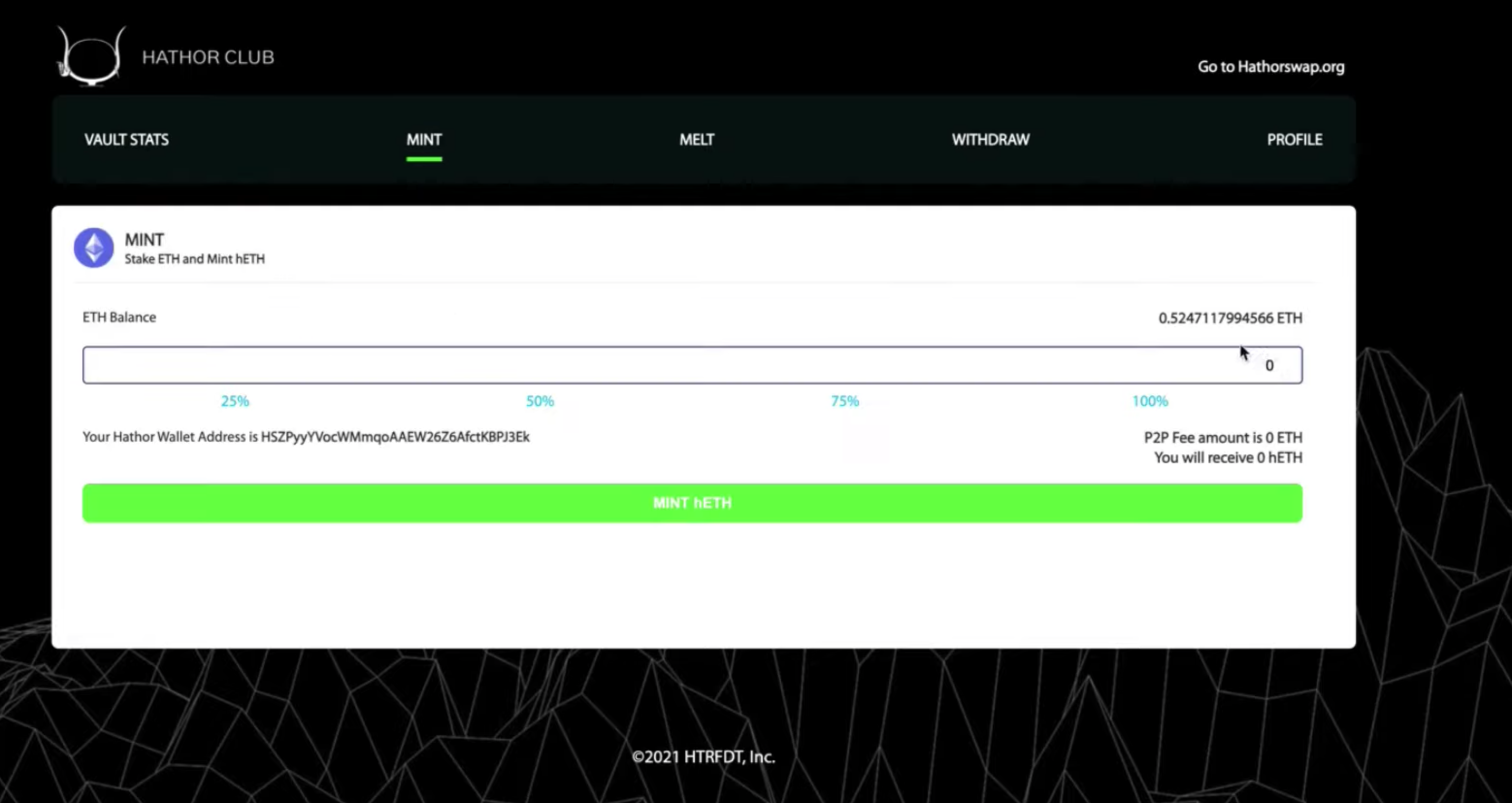
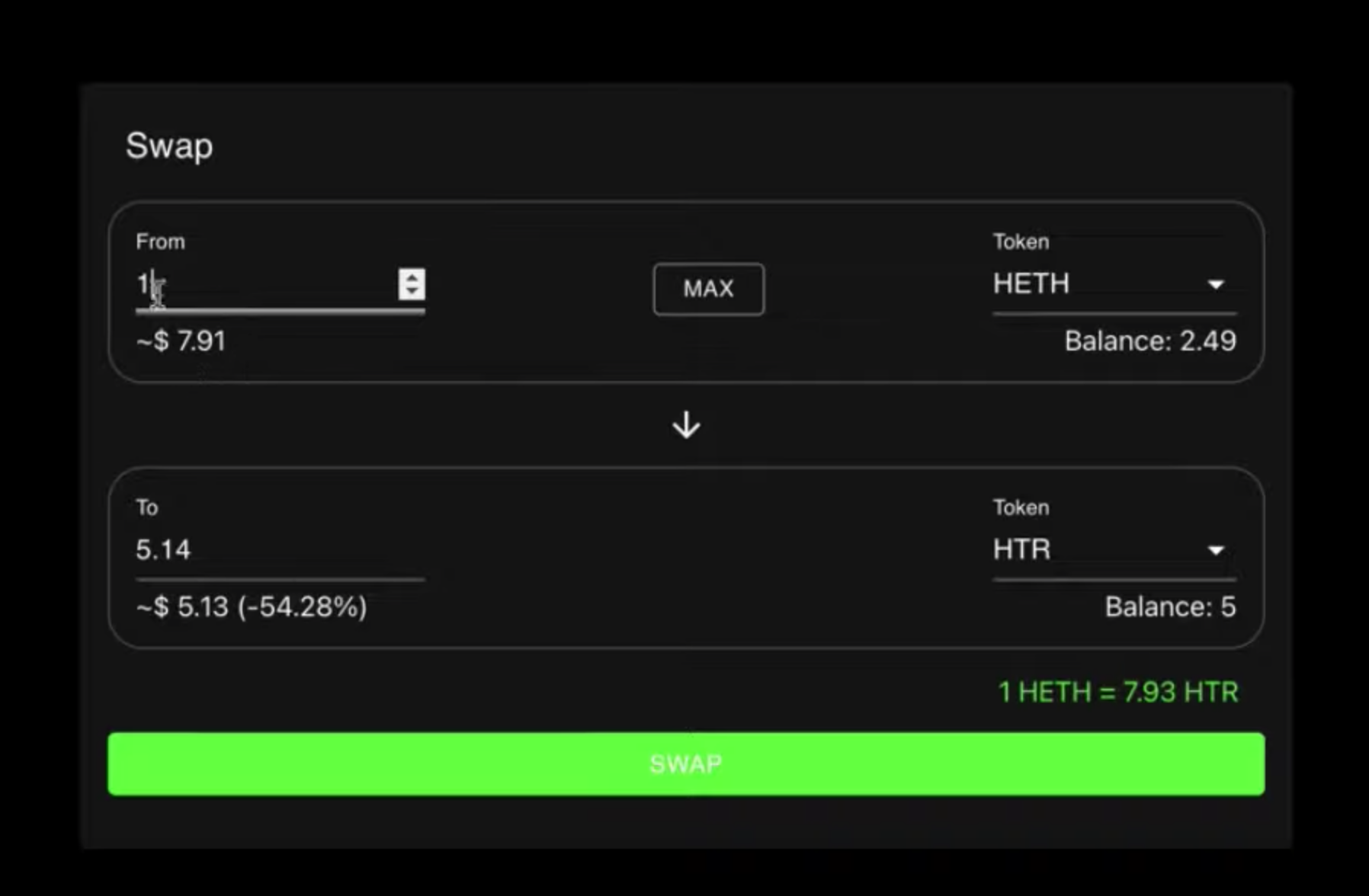
Token Utility
HTR, the native token for Hathor Network will be used in conjunction with the following
➤ Block rewards
➤ Staking rewards
➤ Minting fees
➤ Virtual debit card
➤ WooCommerce
➤ HathorPay
➤ Hathor Swap
Community Incentives
Earn HTR from the below
➤ Liquidity (HathorSwap)
➤ Mining rewards
➤ Zero transaction fees
➤ Bounty rewards
➤ Contributor rewards
Tokenomics
Hathor has no total supply as it is an inflationary project.
The inflation rate will be below 1.1% from Jan 2025. This also means infinite free transactions.
As part of Hathors token economics, 18% of the token supply is locked up in a vault for five years.
Subject to HathorLabs evaluation, these vaulted tokens could be partially or entirely burned
Please see charts detailing the token allocation of pre-minted tokens and circulation supply
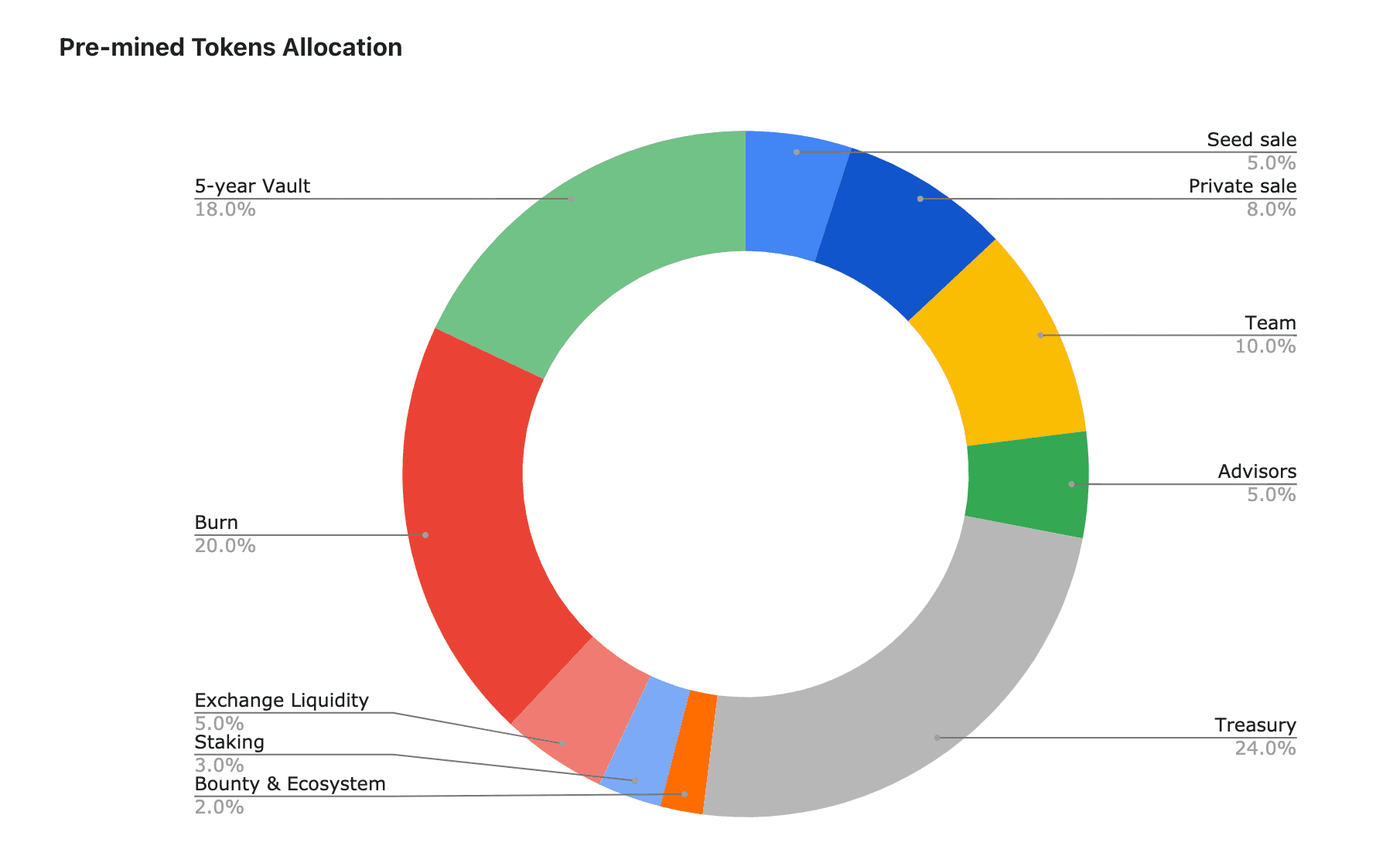
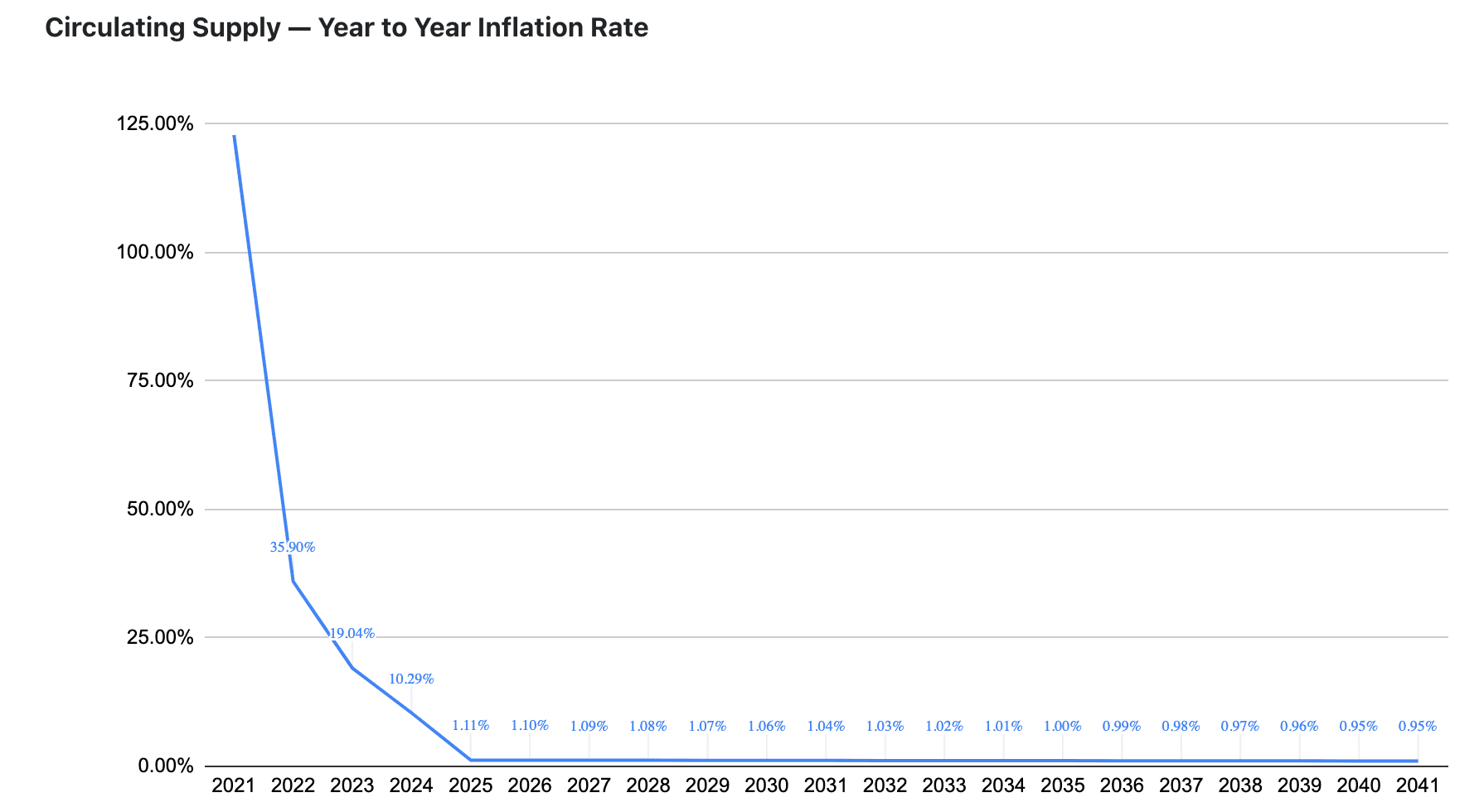
Hathor Network Roadmap
Currently on Hathors roadmap:
➤ Nano Contracts
➤ Oracle Integration
➤ Side-DAG
➤ NFT Support
➤ Cross-Chain Interoperability
NANO Contracts and Oracle – Nano contracts will enable all non-technical individuals to create & configure their own contracts and provide the functionality to their custom tokenized assets on Hathor Network. This is a major step towards mass adoption.
➤ Imagine a simplified, secure, lightweight smart contract that is easily configurable and deployable
➤ No coding or technical knowledge required, with less power consumption and fees
➤ Furthermore, Nano Contracts will also be incorporating Oracles which will blow up the Hathor use case 100x
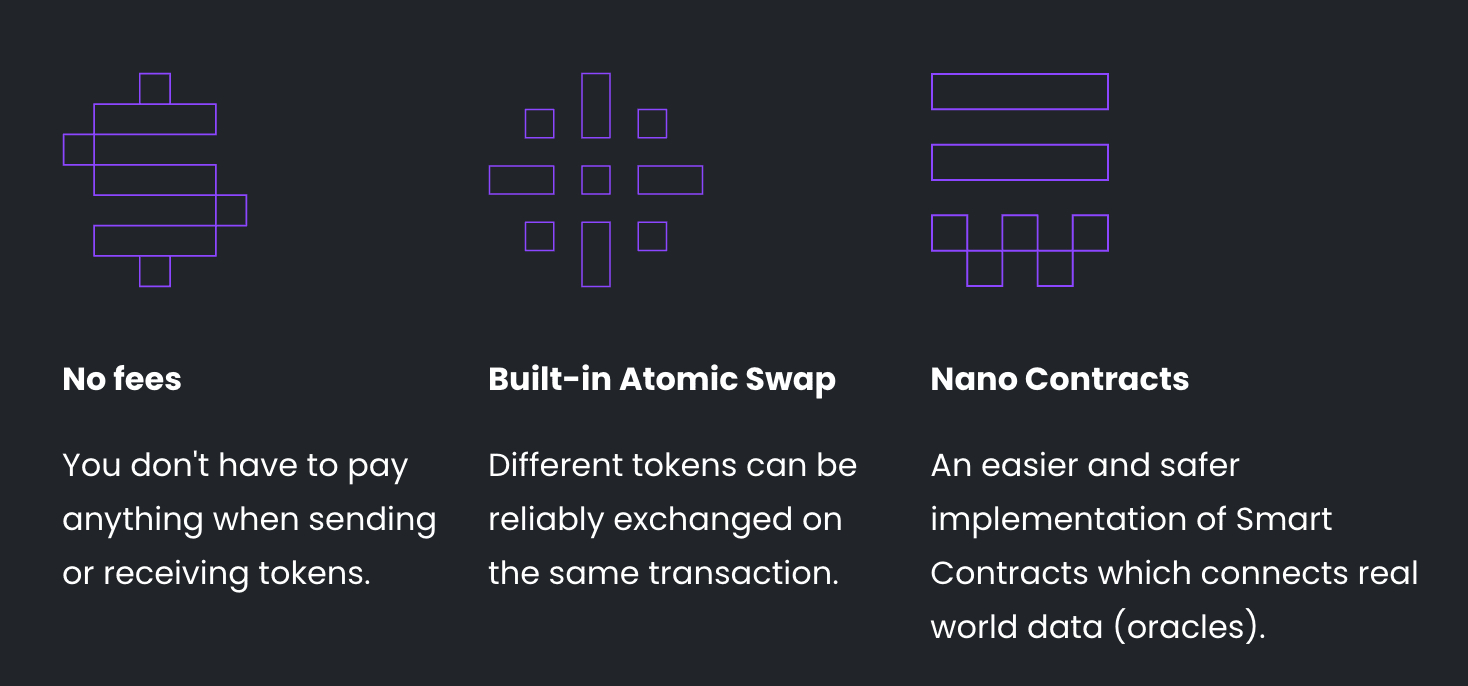
Side-DAG – Currently under development is the Hathor Side-DAG which is essentially a side chain that will independently verify HTR transactions
➤ Configurable to permissioned or permissionless with its own rules and operations
➤ It can be developed and deployed in any language
Built-in Atomic Swaps
➤ This will allow separate tokens to be reliably exchanged simultaneously on the same transactions
➤ Atomic Swaps will improve efficiency in the network, security and increases the possibilities when dealing with token
Cross-Chain Interoperability
➤ This will be a significant milestone for Hathor as it will allow the transfer of information and the exchange of value between chains
➤ Another step forward for the mass adaption of HathorNetwork
Support Services – Hathor Network is now offering Support Services
➤ Tokenization Services – a consulting group for CEOs
➤ A support service for CTOs
➤ A set of turnkey service containers for DevOps & Architects
➤ Library for Engineers & Developers, white-label wallet with good documentation
Hathor Grant Program – Hathor Network is now offering news projects grants in USDT & HRT. New start-ups jump aboard while you can as you also will get professional consultancy services from Hathor Labs
Partnerships
Current partnerships
➤ Hopr
➤ Ankr
➤ Liqi
➤ F2POOL
➤ 9block
➤ HTRFDT
➤ Workaxl
Team
Total Team Members – 27
Developers – 4
Advisors – 5 (experience – Google, Microsoft, QR Capital, Alpine Capital, Arbitrator)
Marketing – 3
Management Experience: (Okex Exch, Rispar Defi, Alpine Capital, Lab21k, Mambo Wifi)
CEO / Co-Founder – Yan Martins – https://www.linkedin.com/in/yan-martins-97804421/
Please see the primary management team and advisors in the images below

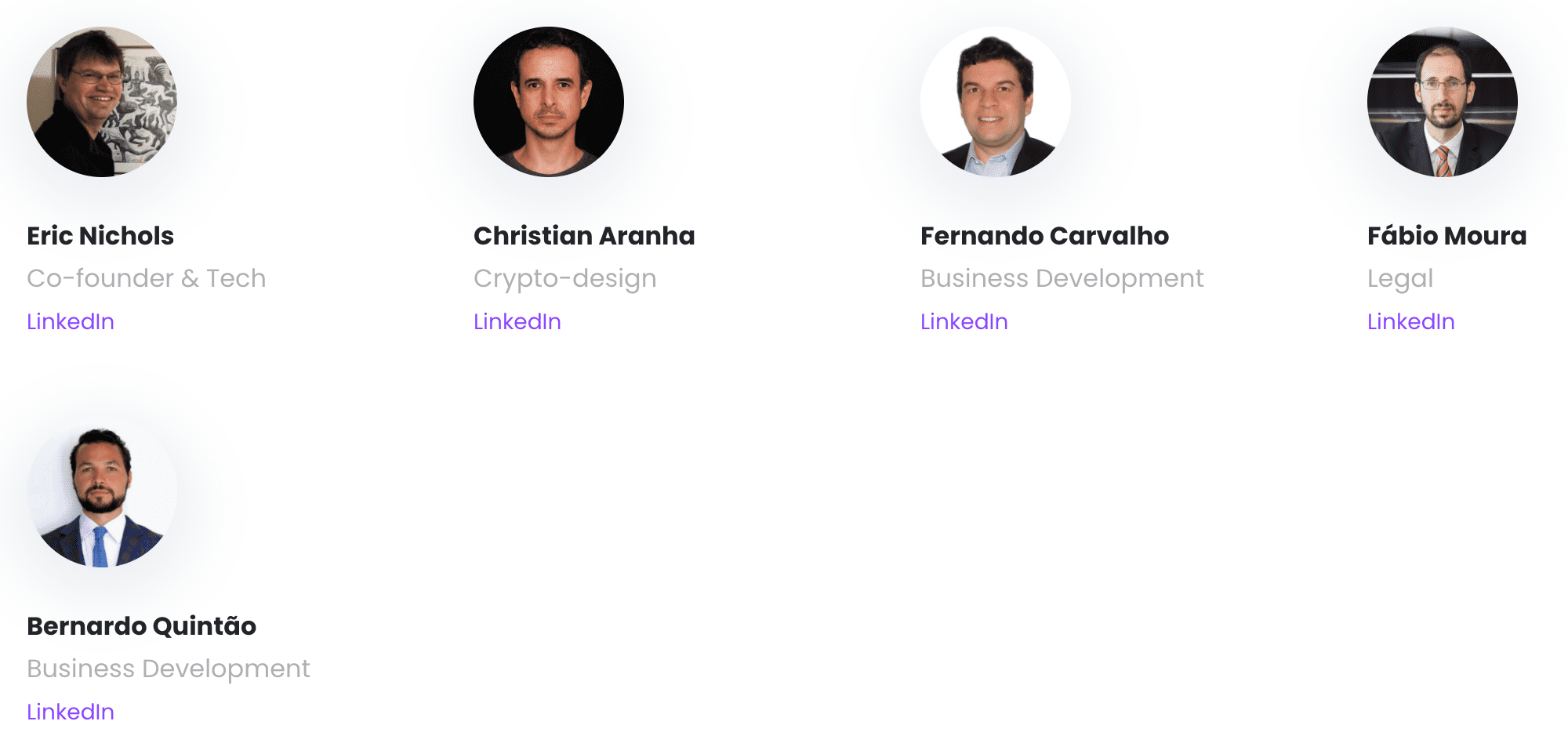
Conclusion
Hathor Network’s primary goal is to build an ecosystem where users with zero technical abilities can tokenize assets, create, configure and deploy Nano Contracts with ease of use. They solve many issues with current blockchains such as scalability, high gas fees, and slow transaction speeds. All this is done while still maintaining true decentralization. With the help of HTR/FDT, Hathor Network continues to add constant value to the project and ecosystem and is one of the most innovative projects in recent times.
Please see summarized results of fundamental analysis below
